
Montessori at Home: Practical Life Activities for Toddlers and Preschoolers
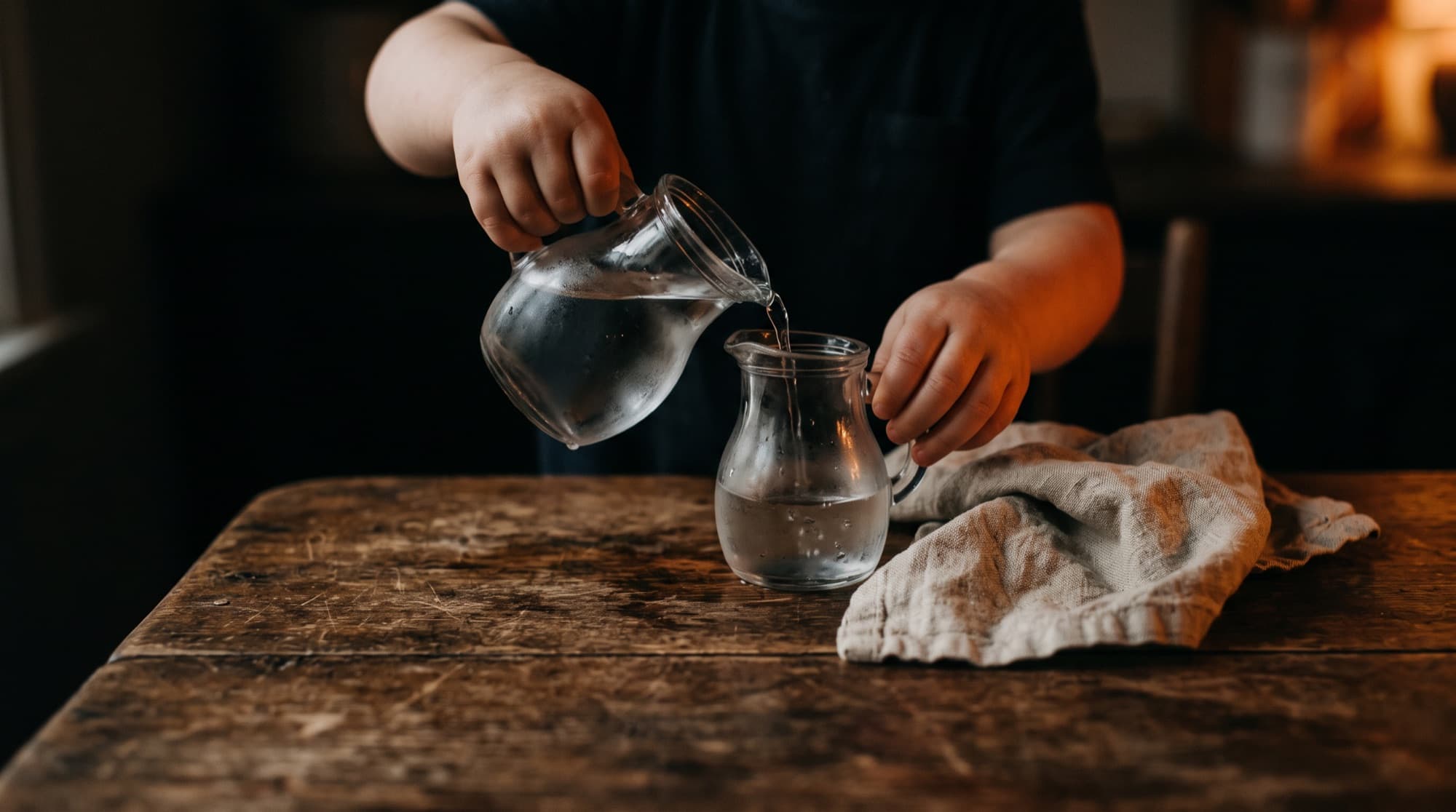
There is a moment most parents recognize. You are pouring a glass of water, and a small hand reaches up and says, without words, "me." The easy answer is to finish the job yourself. It is faster, it is cleaner, and the floor stays dry. The Montessori answer is to pause, hand over the pitcher, and watch what happens next.
This guide is for Surrey families who want to bring that pause into the home. You do not need a classroom, a shelf full of imported wooden materials, or a background in education. You need a few ordinary objects in child-sized versions, a little patience, and a willingness to let a morning take longer than it strictly has to. Everything below can be done with things you probably already own or can find at a thrift store, a dollar store or the kitchen aisle of any hardware shop.
Key takeaways
- Practical life means the real, everyday work of caring for yourself, others and the space you live in: pouring, wiping, folding, washing, dressing, preparing food.
- Children are drawn to this work because it is real, it is purposeful and it is what the adults around them do all day.
- Your first job is to prepare the environment, not to plan activities. A stool, a low hook, a small pitcher and an accessible cloth do more than any activity list.
- Show the movement slowly and quietly, then step back. Your hands teach better than your words.
- Expect mess, repetition and refusals. All three are part of how a child builds skill, and none of them is a sign you are doing it wrong.
- Every child develops at their own pace. The age bands in this article are loose guides, not deadlines.
What "practical life" actually means
In a Montessori classroom, the practical life area is usually the first thing a new child is drawn to. It holds the shelves with small pitchers, tongs, sponges, buttoning frames, polishing cloths and a basket of fresh flowers waiting to be arranged. To an outside observer it can look like play. To the child it is something different: it is work, and a child who is allowed to do real work tends to treat it with real seriousness.
Dr. Maria Montessori, who opened her first children's house in Rome in 1907, noticed that young children kept choosing to imitate the adults around them. They wanted to wash, sweep, carry, serve and tidy. Rather than redirect them to toys, she gave them child-sized tools and let them do it properly. The result was a set of activities built around four broad purposes: caring for oneself, caring for others, caring for the environment, and developing the control of movement that all of these require.
That last purpose is worth noticing. Pouring water without spilling it, carrying a tray across a room, and turning a small tap off just in time are all exercises in coordination, concentration and self-control. They are also, quietly, preparation for handwriting, for reading, for patience at a table and for the larger tasks that come later. But a child does not know that, and does not need to. The child only knows that the pitcher is theirs and the job is real.
Why it works at home
Home is where practical life lives most naturally. Your kitchen, your laundry basket, your front entry and your garden are already full of real tasks, and your child is already watching you do them. The goal is not to create special activities. It is to open a small door so your child can join in what is already happening.
Three ideas sit underneath almost everything in this article:
- Independence is built through doing, not through being told. A child who has poured their own water two hundred times has a different relationship with pouring than a child who has been told how.
- Real tools matter. A small glass pitcher teaches more than a plastic one, because the child learns to be careful when the material rewards care. Choose things that are small, light, and genuinely functional, and supervise anything that could break or hurt.
- Process matters more than result. A wiped table with streaks is still a wiped table. A shirt buttoned one hole off is still a shirt buttoned by the person wearing it.
Preparing the home environment
If you only do one thing after reading this article, make it this: change the height of your home. Most family spaces are built for adults, and a toddler lives in them as a short guest, unable to reach the cup, the coat hook, the light switch or the sink. Every time a child has to ask for help to reach something ordinary, an opportunity for independence slips away.
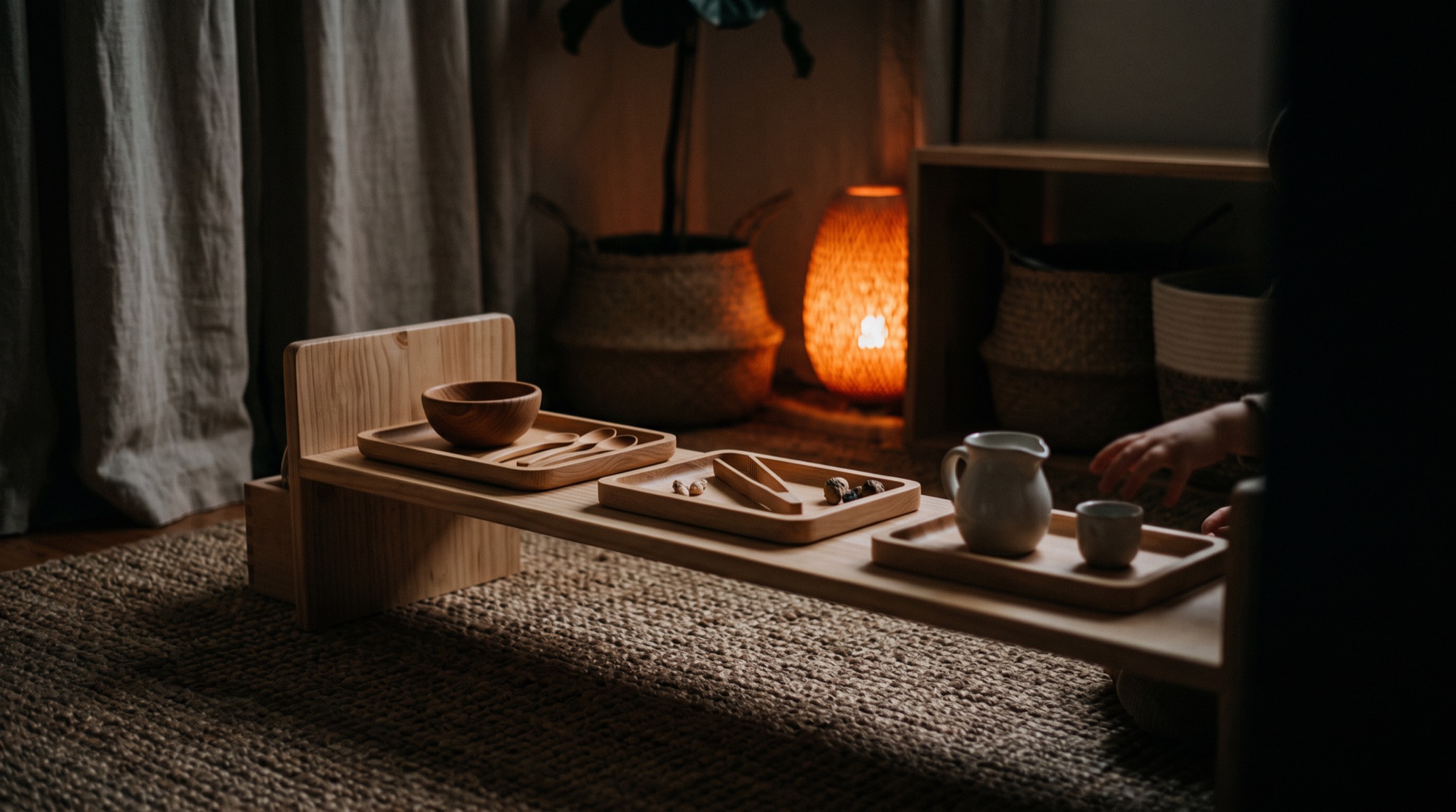
You do not need to renovate. You need to identify the three or four places where your child spends the most time and lower something in each of them.
The five places to start
The entry. A low hook for a coat, a small bench or stool to sit on, and a basket for shoes. Children in the Lower Mainland handle a great deal of weather, and the daily ritual of putting on rain boots and a jacket is practical life at its most useful. Place the hook at your child's shoulder height and keep the number of items small enough that they can see everything.
The kitchen. A sturdy step stool or learning tower at the counter, a low drawer or shelf for their own plates, cups and cutlery, a small pitcher of water, and a cloth. This is the single most valuable change for most families, because the kitchen is where adults spend the most time and where children most want to be.
The bathroom. A stool at the sink, a small towel on a low hook, a mirror at their height and a toothbrush they can reach. Hand washing and tooth brushing become routines the child leads rather than chores the adult enforces.
The bedroom. A low bed or floor mattress if it suits your family, a shelf with a few books facing forward, a small basket of clothes in the next size and a hook for tomorrow's outfit. Fewer choices are better than more.
The living space. One low shelf with a small number of trays or baskets. This is the home version of the classroom shelf, and it is where the activities in this article will live.
Choosing the objects
Practical life materials follow a few simple principles. They are small enough for a child's hands, they are made of real materials such as glass, ceramic, wood, metal and cotton, they are limited in number so that the child can see and put away everything, and they are kept in a place the child can reach.
Start with a short shopping list and expect to spend very little:
- Two small pitchers, one for pouring and one for catching, or a small pitcher and a cup (glass or ceramic, with a wide handle)
- A small tray to contain spills (a baking sheet with a lip works)
- Two or three cloths, one for the table, one for the floor, one for drying hands
- A small sponge and a small bowl
- Child-sized tongs or tweezers, and a few small bowls
- A child-sized broom and dustpan
- A sturdy step stool or a learning tower that cannot tip
- A small apron, optional but a useful signal that the work is about to begin
- A butter knife or a child-safe vegetable knife for later in the 2.5 to 4 range, only with an adult present
One note on safety that applies throughout this article. Glass and ceramic are wonderful teachers, and they can also break. Introduce them only when your child is ready and when you are close. Never leave a child alone with water, knives, hot items, small objects that could be swallowed, or anything that could cause a choking hazard. If your child is still putting objects in their mouth, hold off on beads, small pieces of food and small tools until they have moved past that stage, and always supervise.
How to show an activity: slowly, quietly, once
The way you present an activity matters as much as the activity itself. In a Montessori classroom this is called a presentation, and it follows a simple pattern that works just as well at home.
- Invite. Say, quietly, "I would like to show you something," and wait for your child to come and sit beside you. If they are busy with something else, wait. A presentation given to a child who is not looking is a presentation wasted.
- Slow down. Move at about half your normal speed. Exaggerate the beginning and end of each movement so the steps are easy to see: pick up the pitcher, tilt it, watch the water, stop, set it down.
- Use few words, or none. A running commentary competes with what the child is watching. Name the materials once, then let your hands do the teaching.
- Break the task into small steps. If pouring has six moving parts, show them in order, and do not add more than your child can hold in mind.
- Invite them to try. Hand over the materials. Then sit on your hands, literally if you need to, and let them work.
- Step back. Do not correct unless there is a safety issue. A spill is information, and a child who spills and cleans up learns more than a child who is rescued before the water lands.
It helps to remember that you are showing a movement, not teaching a lesson. Your child is not yet asking "why." They are asking "how," and the answer is in your hands.
If they do it differently from you
They will. Children often reinvent the activity, pouring from the wrong side, carrying the tray with one hand, using the tongs as a spoon. Unless they are unsafe or damaging the materials, let them. Show the intended movement again on another day, without commentary, and trust that the repetition will do the work.
Activities for about 18 to 30 months
Toddlers are driven to move, to carry and to do things over and over. At this stage the activities are short, large-scale and focused on whole-hand movements. The aim is not to produce a polished result but to meet the toddler's strong urge to take part in family life. Many children in this range enjoy the same activity for ten minutes or more, which may surprise you.
Supervise every activity listed here, and skip anything that is not safe for your child's current stage.
Carrying and transferring
Carrying a tray. Use a small, light tray with a few unbreakable objects. Show your child how to hold it with two hands, walk slowly and place it on a table. Carrying becomes a favourite activity, and it quietly builds balance and spatial awareness.
Spooning dry materials. Place a bowl of dry oats, rice or large dried beans on a tray with an empty bowl beside it. Show how to scoop with a large spoon and move the contents across. Large spoons and wide bowls make this far easier than small ones. Keep an eye on any child who still mouths objects, and use oats or a larger material in that case.
Transferring with hands. Large, smooth objects such as wooden blocks, big pom-poms or pebbles too large to swallow can be moved from one bowl to another. This is the simplest form of transfer and is often the best starting point.
Pouring: the first great skill
Pouring is the signature practical life activity, and for good reason. It combines concentration, hand-eye coordination, wrist control and a built-in way to check your own work: either the water ends up in the cup or it does not. Children also seem to find it endlessly satisfying.
The key is to move slowly through stages, so that each step is a small extension of the last. Begin with dry materials, then move to water only when your child has mastered the dry version.
What to expect. There will be spills, and not small ones. Keep a cloth on the tray and make wiping part of the activity. After a few days many children begin to anticipate the spill and reach for the cloth on their own, which is a lovely early sign of order and responsibility.
Cleaning and caring for the space
Wiping a table. Provide a small cloth and a small spray bottle or a bowl of water. Show your child how to wipe from one side to the other in long strokes. Toddlers will often wipe the same spot for a very long time, and it is fine to let them.
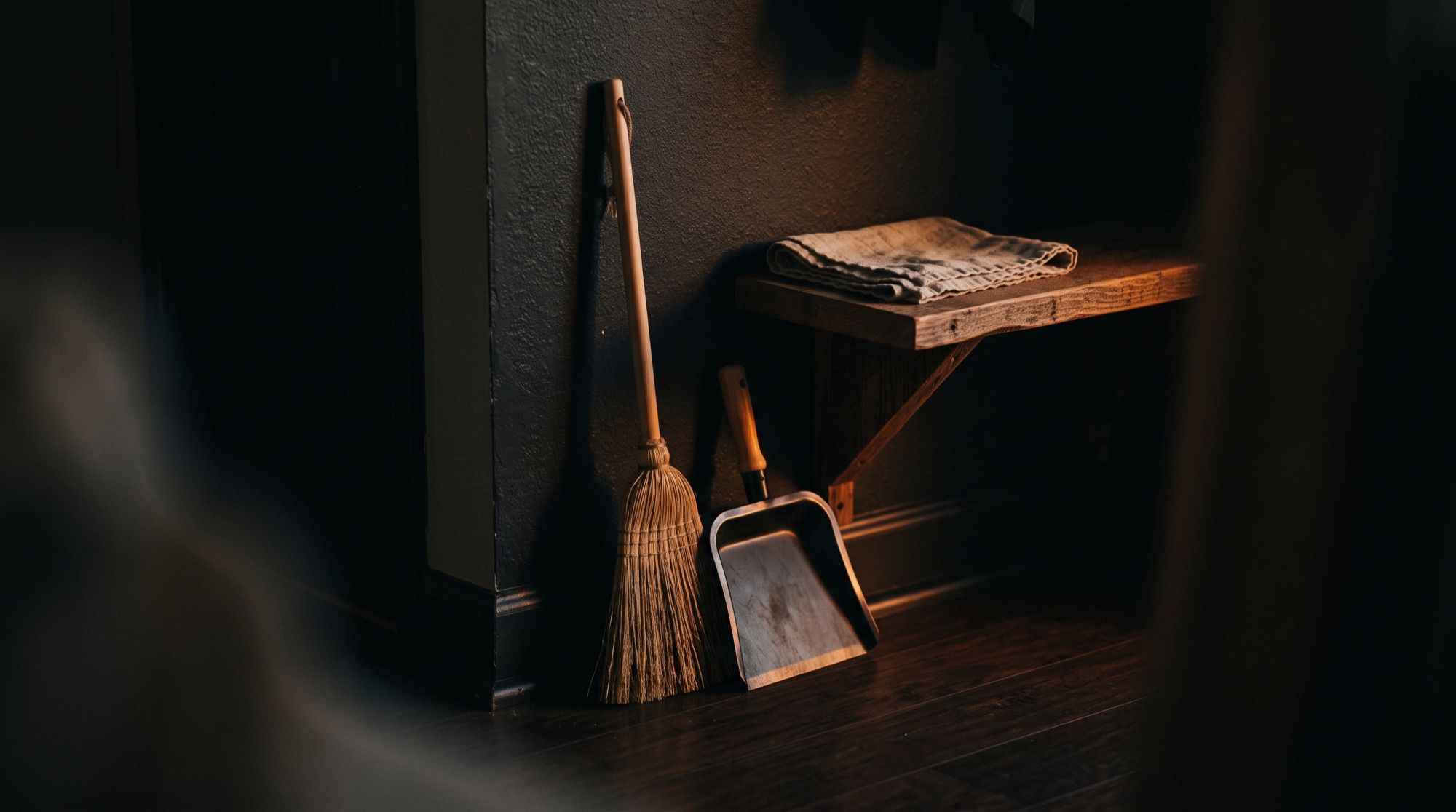
Sweeping. A child-sized broom makes this realistic. Scatter a few dry oats or paper scraps on the floor and let your child sweep them into a dustpan. Do not be surprised if the first week is mostly chasing the pile around the room.
Watering plants. A small watering can and a sturdy houseplant. Show your child how to hold the can with two hands and pour slowly. This is a gentle first experience of caring for another living thing.
Caring for themselves
Hand washing. With a stool at the sink, soap in a pump they can manage and a towel on a low hook, many toddlers can wash and dry their hands with minimal help. Show the sequence once: turn on the water, wet, soap, rub, rinse, turn off, dry.
Putting on a jacket. The classic "flip" method works well: lay the jacket on the floor with the inside facing up, the hood at your child's feet. Your child puts both arms in the sleeves and flips the jacket over their head. It feels like magic the first time it works.
Choosing a snack. A low shelf in the fridge or pantry with two or three snack options they are always welcome to take. A small bowl, a small cloth, a small amount of food. This is where independence meets nutrition meets order.
What to expect at this stage
Expect short bursts, constant repetition and frequent changes of mind. Expect your toddler to abandon an activity halfway through, and to return to it the next day. Expect a very high tolerance for repeating the same movement. This is not a sign of boredom or failure. A toddler who pours water ten times in a row is doing exactly what their body and mind are asking for.
Activities for about 2.5 to 4 years
Somewhere between two and a half and three, many children show a distinct change. They want to do things themselves with a new kind of determination, and "I can do it" becomes a household refrain. They can follow a short sequence of steps, they notice order and fairness, and they are keenly interested in the details of the work. This is a wonderful window for practical life.
The activities in this range involve more steps, finer movements and more responsibility. You are no longer just showing a movement. You are showing a small project with a beginning, a middle and an end.
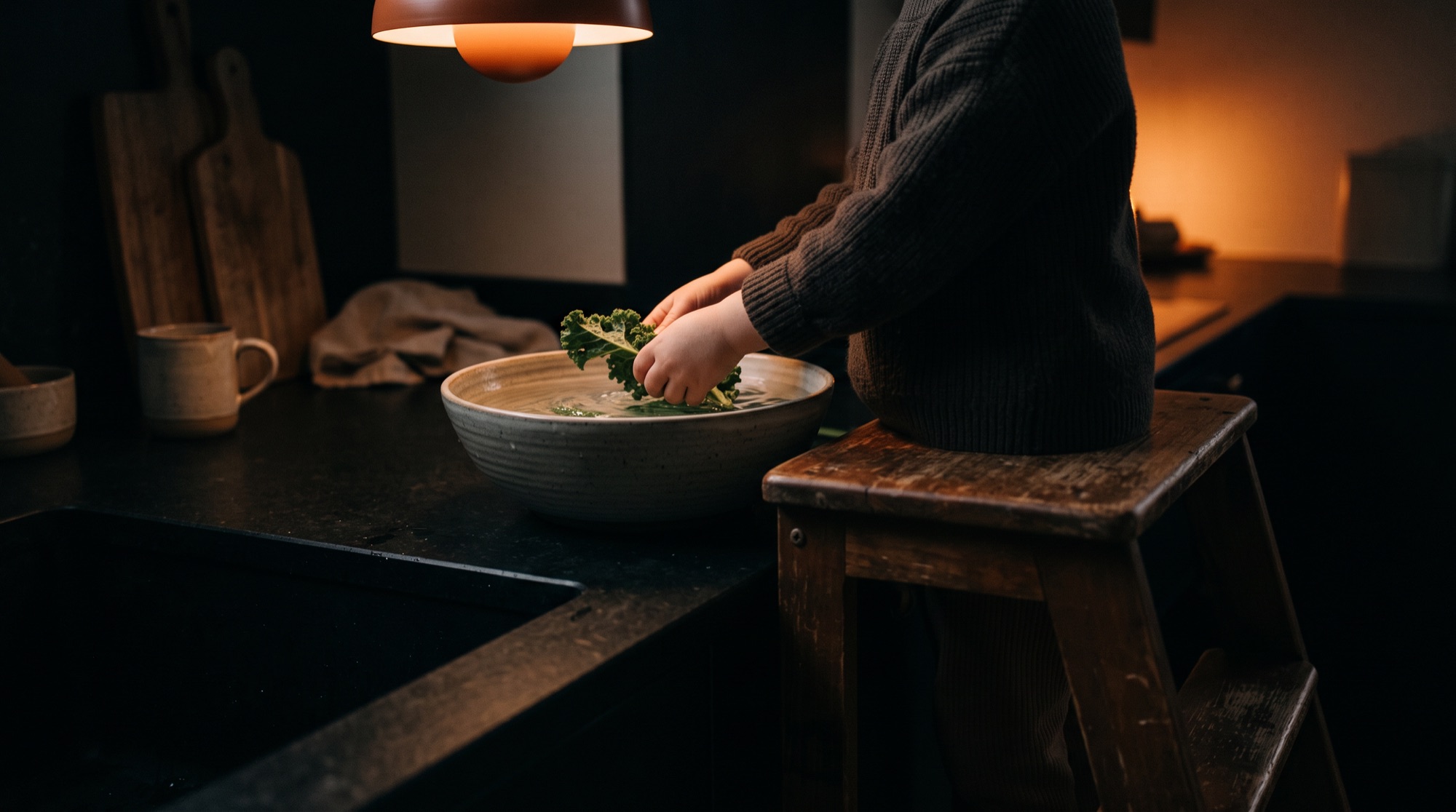
Food preparation
The kitchen is the richest classroom in the house, and children in this age range can contribute meaningfully. Keep tasks short, supervise closely and let the work be real, because they can tell when it is not.
Washing vegetables. Place a bowl of water and a few firm vegetables such as carrots, potatoes or cucumbers on a tray. Show your child how to scrub with a small brush, rinse and place the clean vegetable in a second bowl. This is satisfying, safe and endlessly repeatable.
Peeling a mandarin or a banana. A simple, self-correcting task with a delicious reward. Offer the fruit in a small bowl, and a second bowl for the peels.
Spreading. A butter knife, a slice of bread and something soft to spread, such as nut-free butter, cream cheese or mashed avocado. Show the strokes slowly, from the centre to the edges. Be aware of any allergies in your household and in any shared spaces, and choose foods accordingly.
Cutting soft foods. A banana, a ripe pear or a cooked potato can be cut with a child-safe knife or a sturdy butter knife. Always supervise, hold the food steady for your child if needed, and show them to keep their fingers away from the blade and their knife pointed down. Do not leave a child alone with any knife, even a blunt one. Cutting food for children under four to prevent choking is a separate matter: always cut round foods such as grapes lengthwise, and follow your doctor's or public health guidance for food textures and sizes.
Setting the table. A placemat with the shapes of the plate, fork and cup drawn on it gives a simple visual guide. Many children love this task, and it often becomes a daily responsibility they take pride in.
Pouring their own drink. Move from the pitcher-to-pitcher stage to pouring water into a cup from a small jug at the table. A small mark on the cup, made with a strip of tape, shows how far to pour. Let them pour for a sibling or a parent too. Hospitality is a deeply satisfying idea for a three-year-old.
Care of self
Dressing. Large buttons, zippers and snaps are the main skills at this stage. Practice on a dressing frame or on a spare shirt placed on the floor, then move to clothing that is being worn. Choose a few outfits with easy fastenings in the morning, rather than arguing about a complicated shirt.
Brushing teeth and hair. A mirror at the right height and a few simple tools. Let your child go first, then offer to "finish up" so they feel supported rather than corrected.
Care of the environment
Dusting and polishing. A soft cloth and a small amount of polish or water on a wooden surface. Polishing a small wooden box or a metal spoon is a classic Montessori activity and children return to it again and again.
Folding cloths. Start with small square cloths, folded in half and then in quarters. Many children find the gentle rhythm of folding calming.
Arranging flowers. A few stems, a small vase and a small pitcher of water. Children are often absorbed by this, and it brings some beauty into the home.
Fine motor and concentration work
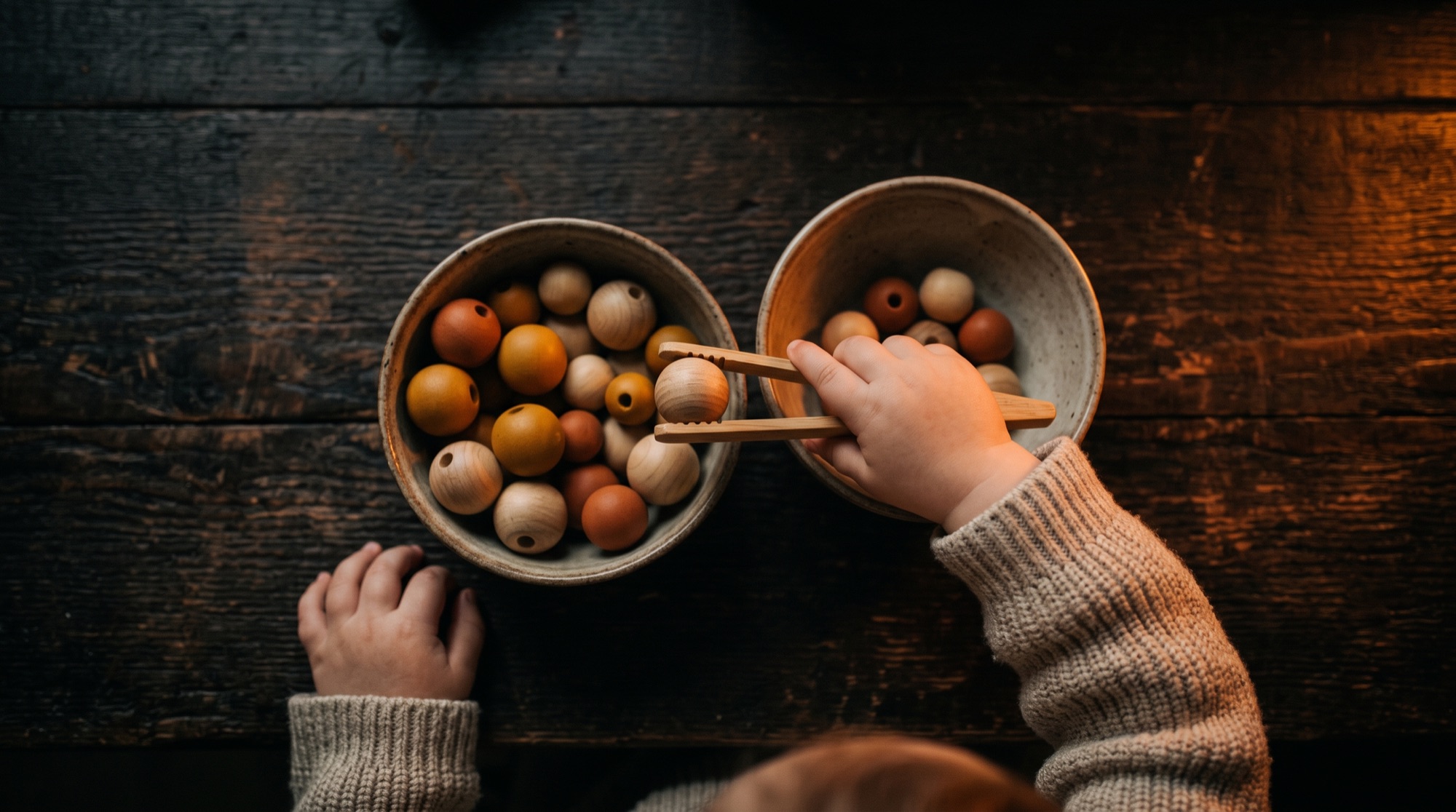
Tongs and tweezers. Moving large beads, pom-poms or cotton balls with tongs, then smaller items with tweezers as skill grows. Use only items too large to swallow and supervise throughout.
Threading. Large wooden beads on a thick lace or shoelace with a stiff tip. Begin with a few beads, then increase. This is a wonderful quiet-time activity, and it gently prepares the hand for writing.
Opening and closing containers. A basket with several jars, boxes and bottles with their lids. Matching lids to containers is a great puzzle and a great way to practise twisting.
Transferring with a sponge. Two bowls of water, a sponge, a tray. The child soaks up the water and squeezes it into the second bowl. This one is a mess in a good way, and it uses the whole hand.
| Activity | Materials | Watch for |
|---|---|---|
| Washing vegetables | Bowl, brush, firm vegetables, tray, cloth | Water on the floor; keep a cloth ready |
| Spreading | Butter knife, bread, soft spread | Allergies; stay close |
| Pouring a drink | Small jug, cup with a marked line, tray | Fragile glass; consider unbreakable cups at first |
| Dressing practice | Large buttons, zippers, snaps | Frustration; offer help only when asked |
| Threading | Large beads, stiff-tipped lace | Small parts; supervise closely |
| Polishing | Cloth, small wooden or metal object | Do not use harsh products |
What to expect at this stage
You will see longer periods of concentration, sometimes twenty minutes or more, and a growing pride in finished work. You may also see more frustration, because your child can now picture what the result should look like and is annoyed when their hands do not cooperate. That is a good sign. It means they care about getting it right. Resist the urge to rescue them, and offer a calm, simple response: "That is tricky. Would you like me to show you again?"
Activities for about 4 to 6 years
By four, many children are ready for work that stretches over a longer period and involves more than one stage. They can plan a little, they can hold a sequence in mind and they are increasingly interested in how things work and in being genuinely useful. The practical life activities at this stage often lean toward real household contributions, and toward care of others in the wider community.
This is also the age when the line between practical life and other areas of learning begins to blur. Measuring ingredients touches on early maths. Writing a shopping list touches on early literacy. Planting a seed touches on science. You do not need to point any of this out. The child is simply doing real work, and the learning arrives as a side effect.
Kitchen projects
Making a simple recipe. Pancakes, muffins, a salad, a fruit plate, or a pot of soup with chopped vegetables. Write the steps on a small card, with a drawing for each, so your child can follow along. Let them measure, pour, stir and wait. Handle anything hot or sharp yourself or stand beside them throughout.
Slicing with a knife. Move from a butter knife to a small, sharper child's knife only when your child shows steady control and always with an adult next to them. Teach the "bridge" and the "claw" grips for the holding hand, and keep to soft, stable foods like cucumber and banana.
Grating. A box grater is sharp, so supervise carefully, and start with soft cheese or a firm vegetable. The motion is wonderfully rhythmic, and the result is a visible pile that signals progress.
Home care
Washing a table or a window. A small bucket, a sponge, a squeegee. The child fills the bucket, wets the sponge, washes in sections and dries. It teaches sequencing, and it is quietly useful.
Laundry. Sort, load, add a measured amount of detergent if you are comfortable, hang, fold and put away. Even a three-step version makes the child a real part of the household rhythm.
Gardening. Planting seeds, watering, pulling weeds and picking herbs. If you live in an apartment, a small tray of herbs or a window box works well. Surrey's mild climate gives a long outdoor season for many plants, so even a modest balcony can offer plenty to do.
Care of others and the community
Welcoming guests. Taking coats, offering a drink, introducing family members. These are gentle social skills practised in real situations, and children are often pleased to have a role.
Caring for a younger sibling. Fetching a diaper, offering a toy, helping with a bottle under supervision. This kind of help can ease the sibling transition and gives the older child a sense of competence.
Writing and sending a note. A short message to a grandparent, a drawing in an envelope, a trip to the mailbox. This pairs practical life with early literacy in the most natural way.
What to expect at this stage
Expect your child to ask for real responsibility and to take it seriously. Expect to be corrected, kindly, when you do something out of order. Expect a growing sense of fairness and a desire to see a project through. You may also find that your child is more critical of their own work, and that is the moment to resist praise and offer your presence instead, a point we return to below.
When it does not go smoothly
Everything above sounds calm on the page. In a real household, with real schedules, siblings, rain, work calls and a child who has decided that today the answer is no, it often is not. Here is how to think about the common difficulties.
Frustration
Frustration is part of learning a skill, and it is usually a sign of engagement, not of failure. When your child gets upset, start by naming what you see in a calm voice: "You are working hard on that button." Then decide whether to wait, to offer help or to simplify.
A good rule is to offer the smallest amount of help that lets the child continue. If the button is stuck, hold the shirt steady and let them push. If the water is spilling, move the tray closer. If a task is simply too hard today, put it away gently and bring it back in a week. Nothing is lost by waiting.
Mess
Practical life is messy, and some of that mess is the entire point. A child who spills learns about volume, gravity and care. A child who is allowed to clean up learns that mistakes are ordinary and fixable.
A few small habits make it easier on you:
- Work on a tray, so spills have a boundary.
- Keep a cloth on the tray at all times, and make wiping part of the activity.
- Use a small amount of water or material, so that the worst spill is small.
- Work on a surface that is easy to clean, or put a towel under the tray.
- Choose your timing. Practical life is easiest when you are not rushing out the door.
Refusal and disinterest
Sometimes your child will simply say no. Perhaps they are tired, hungry, overstimulated or wanting a different kind of attention. Do not push. Say, "That is fine, it will be here when you want it," and move on. The shelf is an invitation, not an assignment.
If a child consistently avoids a particular activity, consider whether it is too hard, too easy or simply not appealing. Swap in something else. Children often come to activities by watching you do them. If you are cheerfully folding laundry nearby, they may join in without ever being asked.
Over-praise
It is natural to want to say "good job" every time your child pours a cup of water. But a steady stream of praise can quietly shift the child's attention from the work to your reaction. They begin to look up and check whether you are pleased, instead of looking at the water and checking whether it is level.
Try something different. Describe what you see, ask a question, or simply share in their pleasure:
- "You poured all the way to the line."
- "You worked on that for a long time."
- "How did it feel when the water reached the top?"
- A smile and a quiet nod, with no words at all.
This is a small shift, but over time it helps a child build their own sense of when something has gone well, without needing an adult to tell them.
Building routines that carry the work
Practical life lives in repetition. A child who pours water at the same time each day, or sets the table before dinner, gains skill and confidence faster than a child who tries a new activity each week. Routines also reduce arguments, because the child knows what comes next and has a role in it.
The most useful routines tend to be anchored to moments that already happen every day:
- Morning: getting dressed, clearing breakfast dishes, feeding a pet or watering a plant.
- Arrival home: hanging up a coat, putting shoes away, washing hands.
- Before dinner: setting the table, helping with a simple kitchen task.
- After dinner: clearing plates, wiping the table.
- Bedtime: choosing pyjamas, brushing teeth, putting clothes in the hamper, choosing a book.
Keep the shelf small and fresh
Aim for four to six items on your child's shelf at any time, and rotate them every week or two based on what they are using. A shelf with too many options becomes a pile, and a child who has too many choices tends to choose none of them. Remove items that have been ignored for a while and bring them back later, and add a new challenge when you see your child mastering the old one.
How home and classroom fit together
The skills your child builds at home are the same skills that support them in a Montessori classroom. In a mixed-age room, children are expected to pour their own water, tidy their own materials, carry their own work to a mat and care for the shared space. A child who has practised these at home often settles into the classroom with a quiet confidence, because the work feels familiar.
At Silver Ridge Montessori, our experienced educators work in mixed-age classrooms in Fleetwood, Cloverdale, Clayton and on 163 Street in Surrey. Children in our Toddler program (18 to 36 months) and our Primary program (3 to 6 years) spend their days in prepared environments where practical life is part of daily routine. If you would like to see how this looks in person, you are welcome to book a tour.
The Infant program (3 to 18 months) is coming soon, and the Elementary program and before and after school care serve children aged 6 to 12. A child who starts with practical life at home has a natural link to every stage that follows.
A gentle note about pace
Every child develops at their own pace. The age bands in this article are rough guides, and your child may move faster in some areas and more slowly in others. Some children love pouring but resist dressing, and some do the reverse. This is normal.
If you have concerns about your child's development, such as movement, speech, attention or social interaction, please speak with your family doctor, a public health nurse or an early-years professional. This article is intended as general information about everyday family life, not as medical or developmental advice.
Frequently asked questions
Do I need to buy Montessori materials?
No. Most practical life activities use everyday objects: a small pitcher, a tray, a cloth, a sponge, a broom. The materials matter less than the principles: small, real, limited in number and reachable.
My child is one and a half. Is that too early?
Not at all, as long as the activities are simple, short and supervised. Carrying a tray, wiping a table and washing hands are all within reach for many children in this range. Follow your child's interest and keep sessions brief.
My child just wants to dump everything out. What do I do?
This is common, and a good sign that your child is exploring. Offer a limited amount of material in a tray, show the intended movement once and let them explore. If dumping continues, put the activity away and try again later. You can also offer a dedicated space where dumping and filling is welcome.
How long should an activity last?
As long as your child wants it to. For a toddler this might be two minutes or twenty. Do not interrupt a child who is absorbed unless there is a safety concern.
What if my home is small?
A small home can be an advantage, because everything is close. A single low shelf, a stool and a hook by the door are enough to begin. Many Montessori families live in apartments and townhouses and make it work with only a few thoughtful changes.
Is it safe to let children use real glass and knives?
With close supervision and at the right stage, many families do. Start with unbreakable materials if you are unsure, introduce glass and knives gradually, and never leave a child alone with them. You know your child best, so trust your judgement about what is right for your home.
A quiet place to begin
If this feels like a lot, start small. Pick one place in your home, perhaps the kitchen, and lower one thing: a stool, a cup, a cloth. Then stand back and watch what your child does with it. You will learn more from ten minutes of watching than from any list, including this one.
When you are ready to see how this approach looks in a classroom, we would love to meet you. Learn more about our Toddler program and our Primary program, or get in touch to arrange a tour.