
Montessori vs Traditional Preschool: How Surrey Parents Can Choose
Somewhere around your child's second birthday, the question arrives. It usually shows up on an ordinary evening, with dishes still in the sink: where should our child spend these years? You open a few tabs. You read the words "play-based," "Montessori," "Reggio-inspired," "academic," "licensed," "nature," and "bilingual," and by the third tab they have started to blur together.
If you live in Surrey, the choice is real, because you have real choices. Between Fleetwood, Cloverdale, Clayton, Newton, Guildford and South Surrey, there are dozens of programs for children under six, and they do not all run the same way. Some are close to what you remember from your own childhood. Some follow a method with a hundred-year history. Many borrow from several traditions at once.
This guide is meant to help you sort them out without pressure. It explains what a Montessori classroom is actually built around, what a traditional preschool is built around, and where each one tends to be strong. It walks through a typical morning in each, so you can picture your own child in the room. It gives you questions to take on a tour, and a simple way to decide that you can do at your own kitchen table.
We run Montessori classrooms, so we have a point of view, and we will say so plainly. But we have also watched families choose well in both directions, and the goal here is not to talk you out of a good traditional preschool. The goal is to help you choose the room where your particular child, with their particular temperament, is most likely to settle in and grow.
Key takeaways
- The biggest difference is who sets the pace. In a traditional preschool the teacher usually leads the group through a planned day. In a Montessori classroom the child chooses from prepared materials, and the teacher guides each child individually.
- Montessori classrooms mix ages (for example, three to six years in one room), so younger children learn by watching older ones and older children consolidate what they know by helping.
- Montessori protects a long, uninterrupted block of work time, traditionally about three hours, so that concentration has room to deepen.
- Traditional and play-based preschools are often strong on group play, music, circle time, and shared themes, and many children thrive there.
- The word "Montessori" is not legally protected, so the quality of the training and the classroom matters more than the sign on the door. Visit in person and watch the children, not only the materials.
- Neither approach is right for every child. Your child's temperament, your family's rhythm, and what you see on a tour should carry more weight than any label.
The short version: who leads the learning
If you only remember one thing from this article, make it this: the most useful way to tell these approaches apart is to ask who decides what happens next.
In a traditional preschool, the adult usually decides. The teacher plans a theme for the week (say, autumn leaves), gathers the children on the carpet, reads a story, leads a song, and then guides everyone through a related craft or activity. The day has a shape, and the group moves through it together. A child who finishes early waits. A child who needs more time is gently moved along, because the next part of the day is coming.
In a Montessori classroom, the child decides much more often. The room is set up with a wide range of activities on open, low shelves, each one complete and ready to use. A child walks to the shelf, chooses a work, carries it to a mat or a small table, and stays with it for as long as it holds their interest. The teacher moves quietly around the room, introducing new materials one child at a time, watching, and stepping in only when a child needs a new challenge or a bit of help.
That sounds like a small difference. It turns out to change nearly everything else: how the room is arranged, how long children concentrate, how mistakes are handled, how children relate to each other, and what the adults spend their time doing.
A little history that explains the design
It helps to know where Montessori comes from, because the classroom makes more sense once you understand the problem it was designed to solve.
Maria Montessori was an Italian physician, one of the first women in Italy to qualify as a doctor. In the early 1900s she began working with children and became fascinated by how they learned when adults stopped instructing and started observing. In 1907 she opened the first Casa dei Bambini, or "Children's House," in a working-class neighbourhood of Rome. The children were young, the building was modest, and the materials were simple. What she noticed there became the foundation of everything that followed.
She noticed that small children, given the right surroundings, concentrated for long periods on work they had chosen themselves. She noticed that they repeated tasks again and again, not because they were told to, but because the repetition was satisfying. She noticed that they wanted to do things for themselves, and that they were often frustrated by adults who did things for them too quickly. And she noticed that they absorbed language, habits, and manners from the world around them with an ease that adults rarely match.
From those observations she built a method with a few core ideas that are still recognizable in a Montessori classroom today:
- The prepared environment. The room, the furniture, and the materials are all sized and arranged for the child, so the child can reach what they need without asking an adult.
- Freedom within limits. Children choose their work, but within a structure: materials are used respectfully, returned to their place, and shared fairly.
- Self-correcting materials. Many Montessori materials are designed so that the child can see for themselves whether they have done it correctly, without a teacher marking the answer.
- Mixed-age groups. Children are grouped in multi-year spans, so each child is sometimes the youngest and sometimes the eldest.
- Uninterrupted work time. A long, protected block of time so that concentration can build.
- The teacher as guide. The adult observes, prepares, and introduces, rather than lecturing the whole group.
Traditional preschool has its own long lineage, drawing on the kindergarten movement, nursery school traditions, and decades of research on early childhood development. It is not a single method, and it is not the opposite of Montessori. It is a wide family of approaches, and many good ones borrow generously from Montessori and from each other.
A typical morning, side by side
Descriptions of educational philosophy only go so far. It is easier to understand the difference by following a child through a morning. What follows are composites, not a description of any one school, and real programs vary. But the shape is accurate for the way each approach tends to run.
A morning in a traditional preschool
Children arrive over about half an hour and drift toward whatever is out: blocks, a play kitchen, a table with puzzles. There is a lot of warmth in this stretch of the day. Teachers crouch down to greet each child, help with coats and bags, and settle anyone who is finding the goodbye hard.
Then comes circle time. Everyone gathers on a carpet. The teacher takes attendance with a song, talks about the weather and the day of the week, and introduces the theme. This week it is apples. She reads a picture book about an apple orchard, the children sing a counting song, and a few of them get to hold a real apple and say what they notice. Some children are rapt. Some are wriggling. Most are somewhere in between, and the teacher gently manages the group as a whole.
After circle, the class splits into stations or a shared activity. Today it is apple stamping with paint, then a sensory bin with plastic apples, then free play. Snack arrives at a set time, and everyone eats together. Outdoor play follows, then a story, then pickup or lunch.
For many children, this is a happy and stimulating way to spend a morning. The pleasures are social: singing together, laughing together, building a shared story about apples. The rhythm is predictable, which is reassuring, and the teacher is a warm, central figure whose attention children seek.
A morning in a Montessori classroom
Children arrive over the same half hour, but the arrival itself is part of the work. A three-year-old hangs her own coat on a hook she can reach, changes into indoor shoes, and walks into the room. She greets the teacher, perhaps with a handshake or a quiet hello, and then looks at the shelves.
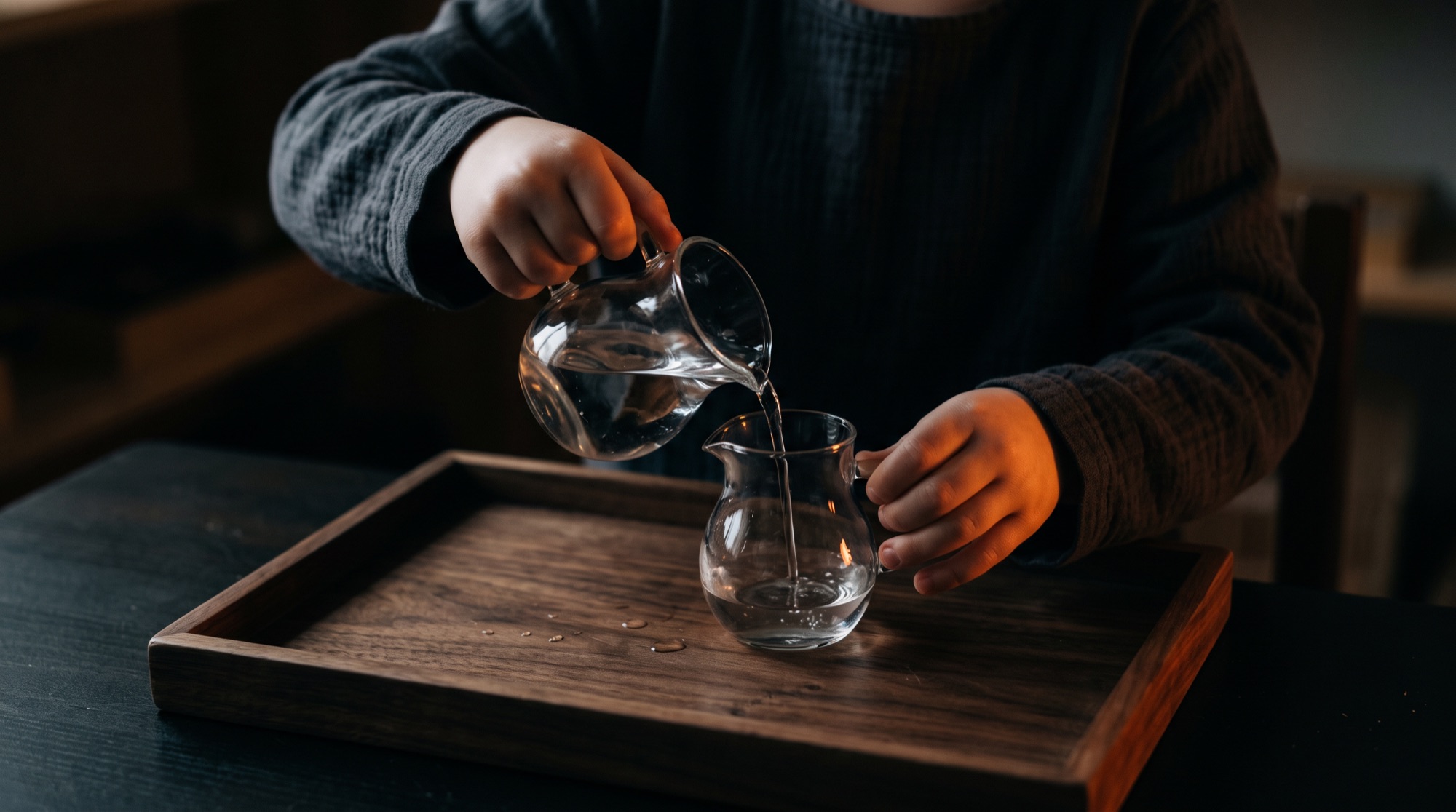
The work cycle begins. She selects a tray with two small pitchers and a sponge, carries it to a mat, and pours water from one pitcher to the other. A few spills happen. She picks up the sponge and wipes them up, because the sponge is part of the lesson. She pours again. Across the room, a five-year-old is building a long chain of golden beads to count into the hundreds. A four-year-old is tracing sandpaper letters with two fingers while saying the sound out loud. Two others are sharing a rug, working with a map puzzle of the continents and murmuring about which piece goes where.
The room is calm, but it is not silent. It hums. The teacher is on the move, kneeling beside one child to give a short lesson on a new material, then stepping back to watch another work through a problem without interfering. If a child finishes, they return the material to its place on the shelf so the next child can use it, and choose something else.
Somewhere in the middle of the morning, a child prepares snack for themselves and a friend: slicing a banana, setting out two plates, pouring water, and cleaning up afterwards. Snack is often open for a stretch of time rather than served to everyone at once, so children eat when they are hungry. Outdoor time comes later in the morning. Many Montessori programs also gather children briefly for a song or a story, but the center of the morning is the long stretch of individual and small-group work.
What the difference looks like from the child's point of view
Notice what each child spends the morning doing. In the first room, the child spends much of the time as part of a group, following the group's pace. In the second, the child spends much of the time as an individual, following their own. Neither is better in the abstract. A child who loves company and shared stories may be thrilled by the first. A child who loves to figure things out, or who tires of the noise of a large group, may find the second a relief.
The skills practised differ too. The apple morning builds listening, turn-taking, and joining in. The Montessori morning builds choosing, concentrating, finishing, and tidying up. Most children need all of them eventually.
Inside the Montessori classroom
If you tour a Montessori room, here is what you are likely to notice, and why each thing is there.
The shelves, the trays, and the materials
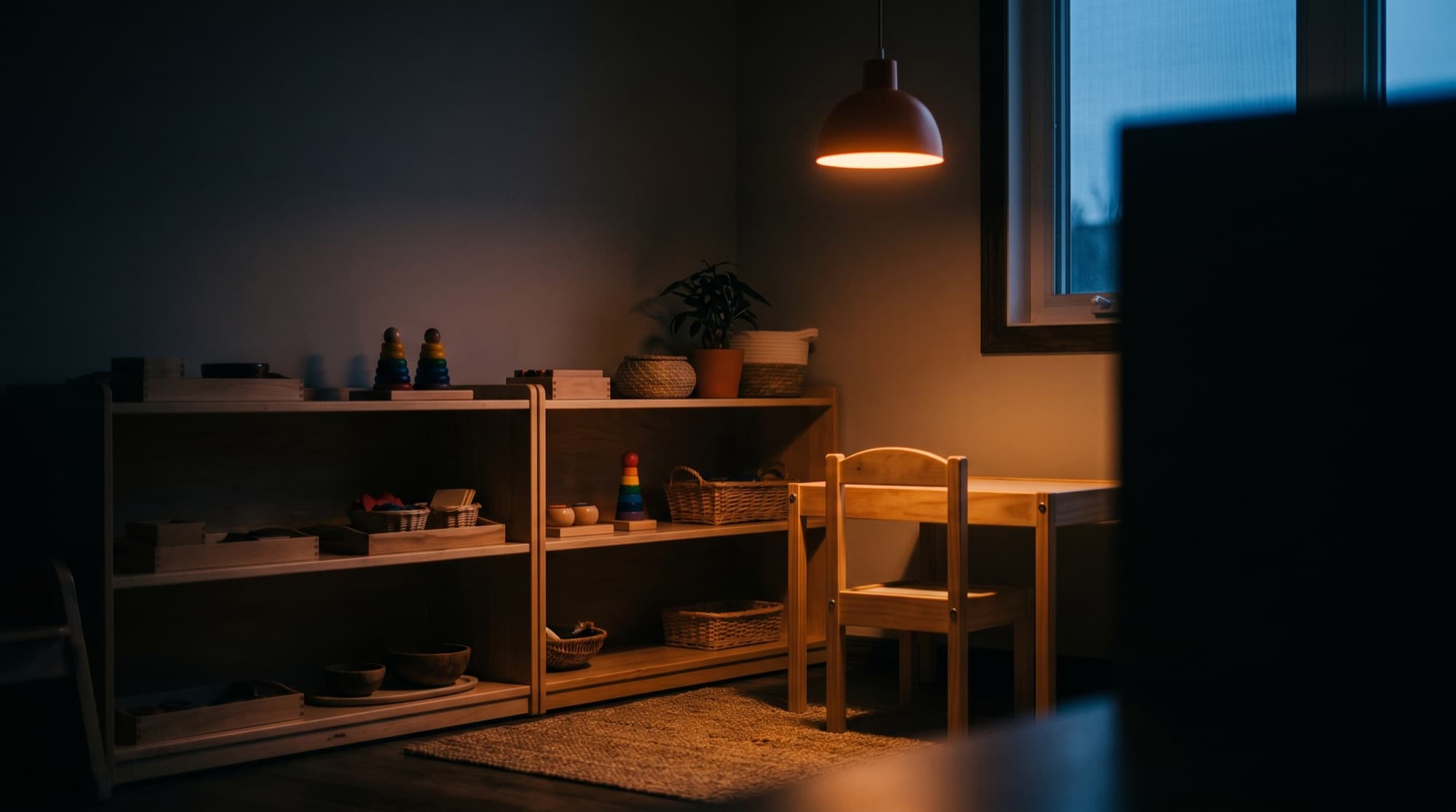
The first thing most visitors notice is how orderly it is. Shelves sit at a child's height, and each holds a small number of carefully chosen activities, arranged from simple to complex. Materials are usually made of wood, glass, metal, or fabric rather than brightly coloured plastic. Each activity lives on its own tray or in its own basket, and each one has a clear beginning and end.
These materials are not random. Many were designed to isolate a single idea. A set of cylinders that fit into matching holes teaches the child to notice differences in size, and the pieces only fit one way, so the child can tell on their own when they have made a mistake. A set of rods that increase in length by equal steps lets a child feel, with their hands, what ten units look like long before they see the numeral. Letters cut from sandpaper let a child trace the shape and say the sound together, so the hand and the ear learn at the same time.
This idea of a self-correcting material is one of the quieter strengths of the method. When a child can check their own work, the teacher's judgement is not the only measure of success. The child learns to look at a result and decide for themselves whether it is right, which is a habit that serves them for the rest of their schooling.
Practical life
Parents are often surprised by how much of a Montessori classroom is devoted to everyday tasks: pouring, spooning, folding napkins, polishing a small brass pot, washing a table, buttoning a frame, arranging flowers. These "practical life" activities look humble, but they do real work. They develop hand strength and coordination that later supports writing. They train the child to carry out a sequence of steps in order. And they give children what many of them are hungry for: the chance to be useful.
If you have ever watched a two-year-old insist on pouring their own juice, you already understand the idea. The child's urge to do real tasks is strong, and Montessori classrooms are designed to meet that urge rather than redirect it.
Mixed ages, on purpose
A Montessori classroom for older preschoolers usually spans three years, commonly three to six. A traditional preschool more often groups children by year of birth, with a room of three-year-olds, a room of four-year-olds, and so on.
The Montessori reasoning is that children learn from each other in ways that same-age grouping can limit. A younger child sees what is possible by watching an older one, and is often more willing to ask a child for help than an adult. An older child strengthens their own understanding by explaining, demonstrating, and sometimes just being patient. Over three years, a child moves from newcomer to experienced member of the room, and leaves as a leader. Many parents describe this arc as one of the most striking things about the method, and the one that takes the longest to appreciate.
The mixed-age group also means that a child is not constantly measured against others born in the same year. A four-year-old working on something a three-year-old might do is simply working on it. A four-year-old doing something a five-year-old would do is simply doing it. The room has room for both.
The adult's role
In a Montessori room, the teacher is often described as a guide. That word can sound soft, so it is worth being specific about the work. A good guide does several things at once. She observes constantly, noticing which materials a child returns to and which ones they avoid. She prepares the environment, rotating materials and keeping the shelves in order. She gives short, precise lessons on new materials, often to one child or two at a time, and then steps back. And she protects the work cycle, quietly preventing interruptions so that children who are deeply concentrating are not disturbed.
The most counterintuitive part is what she does not do. She does not correct a child who is working through a problem unless the child is stuck. She does not praise every effort with a bright "good job," because the aim is for the child to find the satisfaction in the work itself. And she does not need the children's attention fixed on her, because the room is organized so that learning does not depend on it.
This is demanding work, and it depends on training. A well-run Montessori room is the product of teachers who have studied the materials, learned to observe, and practised the art of stepping back. It is one reason why the quality of the adults matters so much when you tour.
What traditional preschools do well
It would be easy for an article written by a Montessori school to treat traditional preschool as the lesser option. That would not be fair, and it would not match what we have seen.
A good traditional or play-based preschool does a number of things beautifully. Here are the ones we see most often.
Rich social play
Young children learn an enormous amount through pretend play with other children: negotiating roles, inventing stories, resolving disputes over who gets the red truck. A play kitchen or a pile of blocks, in the hands of a group of four-year-olds, can become a rich laboratory for language, empathy, and problem solving. Many traditional programs build long stretches of this kind of play into the day, and they are right to do so.
Shared experiences and community
Circle time, songs, themed weeks, and group celebrations give children a sense of belonging. There is something valuable in singing the same song with twelve other children and feeling part of something. Seasonal traditions, class pets, and shared projects build a warm sense of community that many families treasure.
Flexible creativity
Art, music, dramatic play, and movement are often central in traditional programs, and the best ones leave plenty of room for open-ended creativity: painting without a model, building without a plan, dancing without steps. Montessori classrooms include art and music too, but if free, messy, expressive creativity is the heart of what you want for your child, you will find many traditional programs that deliver it generously.
A teacher at the center
Some children thrive on a warm, expressive teacher at the front of the room who tells stories, leads songs, and holds everyone's attention. For children who love to perform, to listen, or to be part of an engaged group, that central presence is a gift.
The point is that both kinds of programs can be excellent, and both can be mediocre. The label does not guarantee the quality. What matters is the particular school, the particular teachers, and the particular fit.
The two approaches compared
The table below puts the main differences in one place. Keep in mind that it describes tendencies. A given Montessori school may be more structured than described here, and a given traditional school may be more child-led.
| Area | Typical traditional preschool | Montessori classroom |
|---|---|---|
| Who sets the pace | The teacher plans the day and the group moves together | The child chooses work and moves at their own pace |
| Age grouping | Usually by year of birth | Usually mixed across about three years |
| Daily rhythm | A sequence of shorter group activities | A long, protected block of chosen work |
| Materials | Toys, art supplies, and themed activities | Purpose-built materials, each with a single clear aim |
| Mistakes | Often noticed and corrected by the teacher | Often built into the material so the child can notice them |
| Role of the teacher | Leads the group, tells stories, directs activities | Observes, prepares the room, gives short individual lessons |
| Pretend play | Usually a central feature | Present, but the focus tends to be on real tasks and real materials |
| Practical life | Sometimes included (snack, tidy-up) | A core part of the curriculum |
| Rewards and praise | Often stickers, charts, or verbal praise | Usually minimal, with the emphasis on the work itself |
| Group time | Frequent and central | Shorter and less central |
Common worries, answered honestly
When families visit us, the same handful of questions come up. They are good questions, and they deserve straight answers.
"Will my child get enough time to play?"
This is the question we hear most often, and it comes from a good instinct. Young children need to play, move, and be silly. The honest answer is that Montessori classrooms are built around real work rather than pretend play, and children usually experience that work as play in the ordinary sense: it is chosen, absorbing, and enjoyable. Pouring, sorting, building, and exploring are not chores to a three-year-old. Children also spend time outdoors, run and climb, and make friends. If imaginative, make-believe play is something you want plenty of, ask any school you visit how it fits into the day, and watch what the children do when the structured time ends.
"Is it too free? Will my child just do what they like?"
The freedom in a Montessori classroom is real, but it is bounded. Children choose their work from what the teacher has prepared and shown them. They cannot take every material at once, leave a mess, or interfere with another child's work. The ground rules are clear and consistent: take care of the room, respect others, return things to their place. Many families are surprised by how orderly a well-run classroom is, and by how much children seem to enjoy that order.
"Will my child be able to sit still and follow instructions in kindergarten?"
Children who have spent years in a Montessori room are used to working independently, finishing tasks, and respecting a shared space, which are all useful in a school setting. They are also used to following a teacher's lead when a lesson is introduced. Kindergarten teachers in the public and independent systems regularly welcome children from both kinds of programs, and children adapt to the rhythm of a new classroom quickly. In our experience, what makes the transition easier is less the method behind the previous school and more the child's confidence and their ability to separate from their family. Both kinds of preschool can build those.
"What about social skills?"
A Montessori classroom is a busy social world, even though it can look quiet at first glance. Children share space, wait for materials, ask each other for help, and settle disagreements with guidance from the teacher. The mixed-age group adds something particular: children learn to be kind to someone smaller, to ask for help from someone bigger, and to share a room with people who are not their exact peers. Teachers also model language for resolving conflicts, often in simple scripts such as "I am still using that. You can have it when I am done."
"Does a Montessori school teach academics?"
Yes. Language, mathematics, science, geography, and culture are all part of the curriculum, introduced through hands-on materials rather than worksheets. A child may learn letter sounds with sandpaper letters, build words with a movable alphabet, and explore addition with golden beads long before they write a sum on paper. Many children are ready for reading and basic number work in their five-year-old year; some are ready sooner and some later, and in a mixed-age room each child moves at their own speed.
The quality question: "Montessori" is not a protected word
Here is something many families do not realize. In most places, including Canada, the word "Montessori" is not legally protected. Any school can use it. That means a sign reading "Montessori" does not guarantee that the classroom follows the method well, or at all. Some programs use a few wooden materials and call themselves Montessori. Others are deeply faithful to the approach.
This is not a reason to be suspicious. It is simply a reason to look closely. When you visit, you can ask about the training of the lead teachers and whether they hold a Montessori credential from a recognized training organization. You can ask how long the work cycle is, whether the classroom is truly mixed-age, and how teachers decide when to introduce a new material. A confident, experienced school will welcome those questions and answer them without defensiveness.
The same goes for any preschool, Montessori or not. Ask about staffing, about teacher experience, and about how the school handles the hard moments of the day: a child who is upset, a conflict over a toy, a child who is not ready to separate. In British Columbia, group child care is licensed, and licensing is handled through the regional health authority. It is entirely reasonable to ask any provider about their licence and to see it.
How to tour any school, Montessori or not
A tour is the best information you will get, and it works the same way whichever kind of school you are visiting. The trick is to look past the brochure and watch the children. Here is a way to use the time.
Before you go
Write down two or three things your child is like. Are they a watcher or a jumper-in? Do they get absorbed in one thing for a long time, or flit between activities? How do they handle noise, crowds, and transitions? How do they separate from you? These notes will help you notice what fits when you are standing in the room and your mind is busy with a hundred other details.
If you can, visit during the morning, when the day is in full swing. A classroom looks very different at nap time or pickup than it does during the main stretch of activity.
What to watch for in the room
- The children's faces. Do they look engaged, calm, and comfortable? Are they absorbed in what they are doing? Occasional restlessness is normal; a room full of bored or anxious children is not.
- The tone of the adults. Listen to how teachers speak to children. Is it respectful, patient, and warm? Do they get down to the child's level? Do they speak quietly, or do they raise their voices to manage the room?
- How conflicts are handled. If you see a disagreement over a toy or a material, watch how the teacher responds. This tells you more about the school than almost anything else.
- The physical space. Is it clean, safe, and set up for children? Can they reach what they need? Is there somewhere calm to retreat to, and somewhere to be active?
- The balance of the day. Ask what a typical day looks like. How much time is outdoors? How much is free choice? How much is group time? How are transitions handled?
- Independence. Are children doing things for themselves, such as putting on shoes, pouring water, or carrying their own plates? Or are adults doing everything for them?
Questions to ask
You do not need a long list, but a few good questions go a long way. These work for almost any program:
- What is your approach to learning, and how does it show up in the day?
- What training and experience do the lead teachers have?
- How many children are in the room, and how many adults?
- How do you help a child settle in during the first weeks?
- How do you handle a child who is upset, or who is struggling with another child?
- How do you communicate with families, and how often?
- How do you help children prepare for kindergarten?
If the school is Montessori, a few more are worth asking:
- Is the room mixed-age, and across what range?
- How long is the uninterrupted work period?
- What Montessori training do the lead teachers hold?
- How do children choose their work, and how do teachers guide that choice?
After the tour
Sit with your impressions for a day or two before deciding. Ask yourself: Could I picture my child here? Did the adults seem like people I would trust with them? Did the children seem happy? If you toured more than one school, compare them by how each one felt, not only by what it offered. It is common to be impressed by a long list of features and then realize that the place that felt right was the simpler one.
If you can, ask whether your child can visit for a short time. Seeing how they react to the room, the materials, and the teacher is more informative than anything a parent can predict.
A simple way to decide
When families ask us which kind of program to choose, we do not start with the method. We start with the child. The diagram below is a way to organize your thinking. It is not a test, and no answer is wrong. It is a way of noticing which questions matter most for your family.
Which Silver Ridge program, if you do choose Montessori
If you decide to explore Montessori, the program you look at depends on your child's age. Our Toddler program welcomes children from 18 to 36 months, and is often a child's first step into a classroom, with an emphasis on movement, language, and early independence. Our Primary program serves children from three to six years in a mixed-age classroom, and is the heart of the Montessori method as described in this article. Our Elementary and before and after school program serves children from six to twelve. An Infant program for children from three to eighteen months is coming soon.
We run classrooms in Fleetwood, Cloverdale, Clayton, and on 163 Street in Surrey, with experienced educators in each. If you are unsure which location suits your family, tell us where you live and work, and we can help you think it through.
Frequently asked questions
At what age can a child start Montessori?
Montessori programs exist for every stage from infancy through adolescence. Many children join in the toddler years or at around age three, when the classroom is designed to welcome them. There is no deadline for starting. Children who join later adjust, and good teachers know how to introduce a new child to the room, the routines, and the materials at a pace that works for them.
Can my child move to a traditional kindergarten afterwards?
Yes. Children move from Montessori programs into a wide variety of kindergartens every year. Teachers and parents commonly find that these children are comfortable working independently and looking after their own belongings. It can help to talk with your child ahead of time about how the new classroom will be different, to visit the school together, and to arrange a few play dates with future classmates.
What if my child is shy, or takes a long time to settle?
A calm, predictable classroom can be a good place for a cautious child, because they can watch for as long as they need before they join in. Ask any school about its settling-in process. A good one will talk with you about how to make the first weeks gentle, and will tell you honestly how your child is doing.
Should I choose based on the method, or the school?
The school. A thoughtful, warm, well-run program of any kind will usually serve your child better than a poorly run one of the kind you thought you preferred. Start with the method if it helps you narrow the field, then let the visit decide.
Choosing with a steady mind
It is natural to feel that this choice carries weight. You are choosing where your child will spend long stretches of their days at an age when the world is wide open to them. But it helps to remember that children are resilient, and that your involvement matters more than any single decision. A child who is loved, listened to, and read to will do well in a variety of settings. What a good school adds is a room where those same qualities are present for part of every day, along with the chance to build independence, friendship, and curiosity.
If you take one practical step this week, make it a visit. Spend half an hour in a room, watch the children, and notice how you feel. Then do it again at a different kind of school, if you can. You will learn more from those two visits than from any article, including this one.
If you would like to see a Montessori classroom for yourself, we would be glad to show you around. Read more about our Toddler, Primary, and Elementary programs, or get in touch to arrange a tour. Come and watch a morning unfold, ask whatever you like, and take as much time as you need.