
What a Day in a Montessori Classroom Actually Looks Like
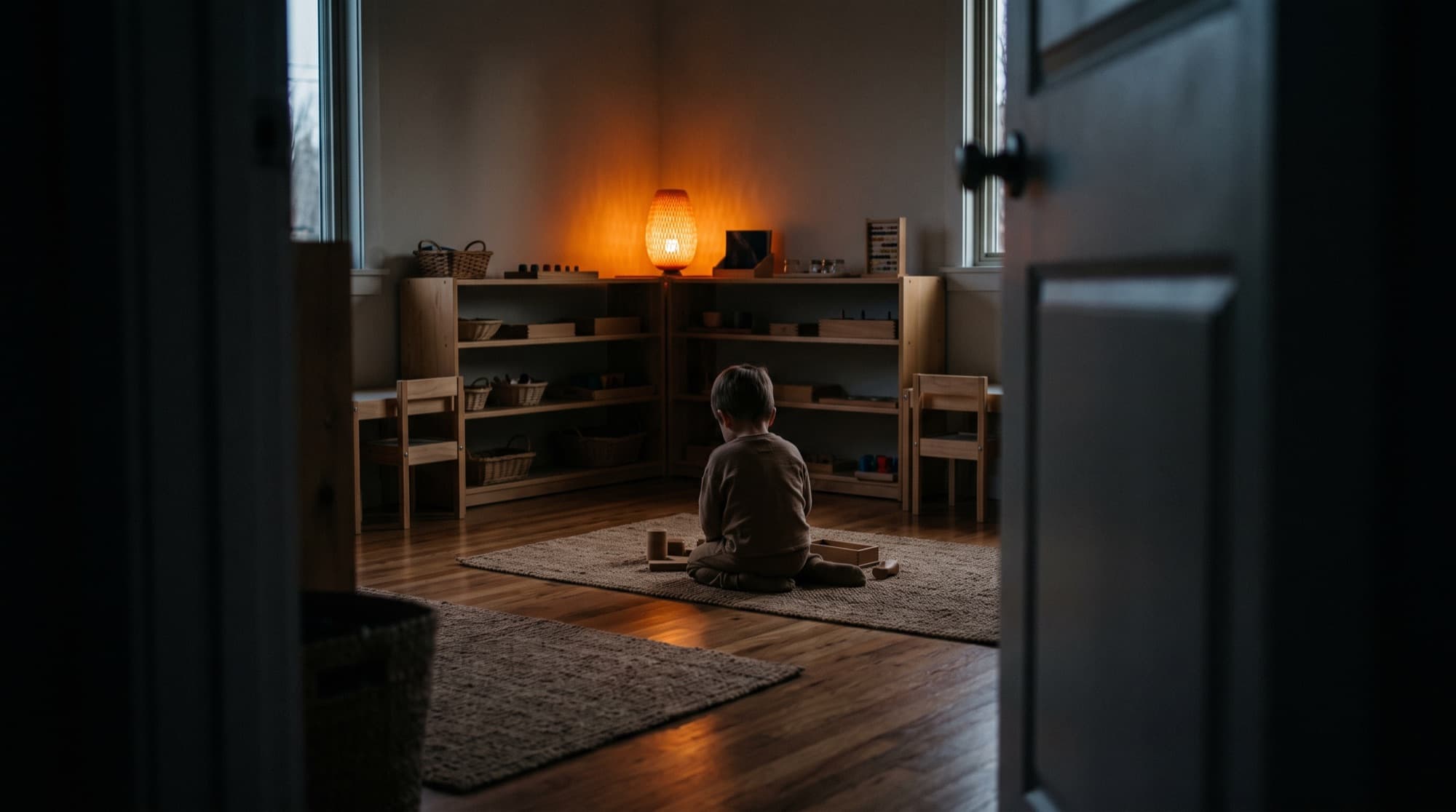
If you are reading this before a first tour, there is a good chance you have a picture in your head of what a classroom is. Rows of small desks, a teacher at the front, a bell, a line at the door. Then you walk into a Montessori room and the picture does not hold. Children are spread across the floor on woven mats. One is carrying a tray with both hands, very slowly. Another sits alone with a stack of wooden cubes. An adult is kneeling beside a child and, as far as you can tell, not saying much at all.
It is a lot to take in on a first visit, and it is easy to leave with a good feeling and a long list of questions. What are they all doing? Who decides? What happens if a child just wanders? Is anyone teaching? And the one underneath the rest: what will my child's actual day feel like?
This guide walks through a single day, hour by hour, the way an observer sitting quietly in the corner might see it. It covers children from about 18 months to 6 years in some detail, because that is where most families begin, and then looks at what changes for children aged 6 to 12 in elementary and before and after school care. Along the way it explains the reasoning behind what you see, so that the next time you stand in a doorway watching a three-year-old polish a small brass pitcher for twenty minutes, you will know exactly what you are looking at.
Key takeaways
- A Montessori day is built around a long, uninterrupted block of self-chosen work, traditionally about three hours, rather than a series of short teacher-led lessons.
- The room is deliberately prepared: low shelves, child-sized furniture, and a small number of beautiful, purposeful materials, each with a place.
- The adult in the room, often called the guide, spends most of the morning observing and giving short individual lessons, then stepping back.
- Children of different ages share a room. Younger children learn by watching, older children consolidate what they know by helping.
- Freedom is real but bounded. Children choose their work, and they also follow a small set of ground rules about safety, respect and care for the room.
- Progress is observed and recorded closely rather than graded, and the first few weeks usually include some tiredness and some tears, which are normal.
A note before we begin
The day described here is a composite. It is drawn from the shape that most Montessori classrooms share, not from a minute-by-minute timetable at any one school. Real schedules vary by program, by age group and by campus. A toddler room will move more gently and with more rest than a classroom for five-year-olds, and an elementary program has a rhythm of its own. At Silver Ridge, the best way to see the specifics for your child's age is to visit the room and watch for a while. The tour checklist near the end of this guide is meant to help with exactly that.
One more thing is worth saying up front. Maria Montessori was a physician and educator who opened her first Casa dei Bambini, or Children's House, in the San Lorenzo district of Rome in 1907. Almost everything described below comes from what she saw when she watched young children closely and then changed the room, not the child, to fit what she saw. When something in a Montessori classroom seems odd at first, the explanation is usually a patient observation of how small children actually behave.
The shape of the day at a glance
Before the detail, here is the overall outline. Think of it as a rhythm rather than a schedule: a calm arrival, a long stretch of focused work, a shared meal, time outside, a quieter afternoon, and a gentle close.
Arrival: the transition at the door
The day begins at the door, and the door matters more than most parents expect. For a small child, the step from home into a room full of other people is the biggest transition of the morning. A good Montessori arrival is unhurried and quiet on purpose.
Picture a three-year-old who arrives with a parent, hangs a jacket on a hook at her own height, and swaps outdoor shoes for indoor ones. Nobody does it for her. A small bench is nearby so she can sit to change. Her name or a small picture marks her hook. These details look like housekeeping, but they are the first lesson of the day: this is a place built for you, and you are capable of managing your own belongings in it.

A guide meets the child at eye level, usually kneeling or crouching, and offers a simple greeting. Many classrooms also teach a small ritual of arrival: a handshake, a look in the eye, a spoken good morning. It is not a performance. It gives the child a clear, predictable way to move from the world of the parent to the world of the room, and it tells the guide at a glance how the child is arriving that day. Tired, bright, wary, silly: a good guide notices all of it in those first few seconds.
The goodbye
Goodbyes deserve honesty. Some children walk in without looking back. Others hold on to a leg. Experienced educators generally encourage a short, warm and confident goodbye rather than a long one, and discourage slipping out while the child is distracted, because a child who finds a parent has vanished learns that goodbyes cannot be trusted. A calm sentence works well: "I am going now, and I will be back after lunch." The guide can then take over, often by inviting the child to carry something, water a plant or choose a first piece of work. Something small and useful to do is a gentle bridge between feeling worried and feeling at home.
If your child cries at the door, you are not doing it wrong, and neither is the classroom. Crying at drop-off is very common in the first days and weeks, and it often stops within minutes of the parent leaving. Ask the guide how long it lasted once you were gone. The answer is frequently a surprise, and a reassuring one.
The three-hour work cycle
The centre of the Montessori day is the work cycle. In classrooms for children aged three to six, this is traditionally a block of about two and a half to three hours of uninterrupted time in the morning, during which children choose their own work and move at their own pace. Toddler programs generally keep the same idea in a gentler, shorter form, with more room for movement, snack and rest.
This is the feature that most separates a Montessori day from a conventional one, so it is worth understanding why it exists.
Why uninterrupted time matters
Maria Montessori noticed that young children can reach a state of deep, calm concentration when they are given something that genuinely interests them and are left alone to finish it. She also noticed how easily that state breaks. A bell, an announcement, a transition to a group activity, even a well-meaning adult stepping in to help: any of these can end a child's focus before it has fully formed. Over time, children who are constantly interrupted tend to stop reaching for deep focus at all.
The work cycle is the practical answer. By protecting a long block of time, the classroom gives each child the chance to settle, choose, begin, struggle, repeat and finish. Often the first half hour is a warm-up: children wander a little, take on something easy or familiar, watch others. Then, usually somewhere in the middle of the morning, the room deepens. You can feel it. Children who were moving about are now absorbed, and the whole room seems to lower its voice.
What a child actually does in it
Here is what a single morning might look like for a four-year-old, described as an observer might see it.
He begins with a pouring work: two small pitchers and a tray, with a sponge nearby. He pours water from one to the other, spills a little, wipes the tray, and pours again. He repeats it six or seven times. Nobody tells him to stop or to hurry. Then he returns the pitchers to the shelf exactly where he found them, because the next child should find the work ready.
Next he walks to the shelf of wooden cylinder blocks and carries a block to a mat. He takes out all the cylinders, mixes them up, and puts them back. Each cylinder fits only one hole, so when one is left over he knows something is wrong and tries again. The material tells him whether he has succeeded, with no adult needed. This feature, called control of error, is built into many Montessori materials. It lets a child discover and correct his own mistakes privately, without the sting of being told he is wrong.
After a break to watch an older child work with beads, he asks the guide for a lesson on a new material. She kneels and shows him, using few words and slow, clear movements. Then she steps away and he tries it himself.
Nothing in that morning was assigned. All of it was learning.
The prepared environment
Montessori called the classroom the prepared environment, and she meant it literally. Every part of the room has been set up, with care, to make independent learning possible for a very small person.
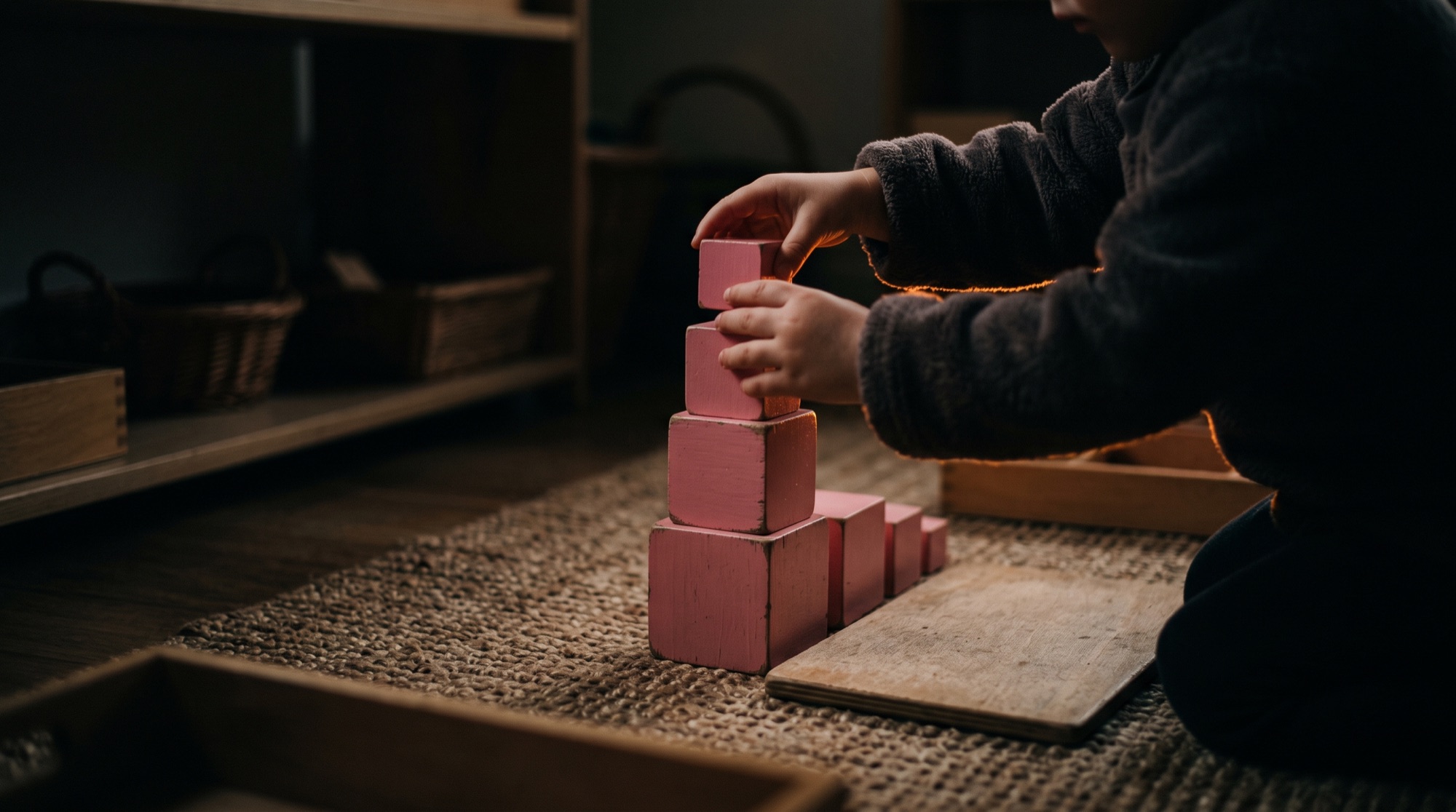
You will notice a few things straight away. Shelves are low, so a child can see and reach everything without asking. Furniture is child-sized, so a chair is something a small person can pull out and sit in. Materials are made of wood, glass, metal and cloth rather than plastic where possible, because real materials have weight and texture and a satisfying way of breaking if dropped. Each material has its own place on the shelf, and the shelves are arranged in an order that gradually moves from simple to complex.
The room is also uncluttered. There is one of each material, not twenty. This is deliberate: if two children want the same work, they learn to wait, to watch, or to choose something else. It is a very small, very real lesson in patience and respect.
The five areas of the room
A traditional Montessori classroom for children aged three to six is organised into areas, each holding a family of materials. The exact layout differs from room to room, but the same five areas appear almost everywhere.
Practical life is where many children start, and where very young children spend much of their time. These are real, everyday tasks scaled to small hands: pouring and spooning, buttoning and zipping on dressing frames, washing a table, polishing, arranging flowers, preparing food, caring for plants and animals. They look simple, and that is the point. Each one builds concentration, coordination, order and independence, and each lets a child do something that matters in the real world. A child who has learned to pour carefully is also learning to control the movement of her hand, to follow a sequence from start to finish, and to feel like a capable member of a community.
Sensorial materials let children refine their senses by sorting, matching and grading the world: from large to small, from rough to smooth, from loud to quiet, from dark to light. The pink tower, a stack of ten cubes that decrease in size, is probably the best known. Children build it, take it down and build it again. Underneath, they are developing visual discrimination and the early ideas of order and size that later support mathematics.
Language begins with sound, not with letters. Young children play with the sounds in words, then meet sandpaper letters, where they trace a letter shape with their fingers while hearing its sound. This links sight, touch and sound at once. Later they build words with a movable alphabet, a box of loose letters, long before they are asked to hold a pencil for long. Writing, in this approach, tends to come first, and reading follows naturally for many children.
Math starts with concrete quantity. Children handle rods of different lengths, beads grouped in tens, and counters in sets, so that a number is something they have held, not only seen. Abstract written numbers come later, when the child already knows what they stand for.
Culture covers geography, science, nature, music and art. A tray of land and water forms, a puzzle map of the continents, a collection of leaves or shells, a tray for planting seeds. These materials invite curiosity about the wider world in a way that is simple, tactile and open-ended.
The guide: observe, present, step back
In a Montessori room the adult is usually called a guide rather than a teacher, and the difference is a real one. A guide does not stand at the front and direct the morning. Her work is quieter and, in many ways, harder.
Observe
A guide spends a great deal of the work cycle simply watching. She notes which children are deeply engaged and which are drifting, which materials are in demand, who is ready for something harder, and who is stuck. This watching is not passive. It is what makes every other decision in the room possible. Many guides keep brief notes as they go, so that nothing seen is forgotten.
Present
When a child is ready for a new material, the guide gives a short, individual lesson. She kneels beside the child, shows the movements slowly and precisely, uses very few words, and invites the child to try. A presentation might last a minute or two. It is the opposite of a lecture. The aim is to show the child how to begin, and then to get out of the way.
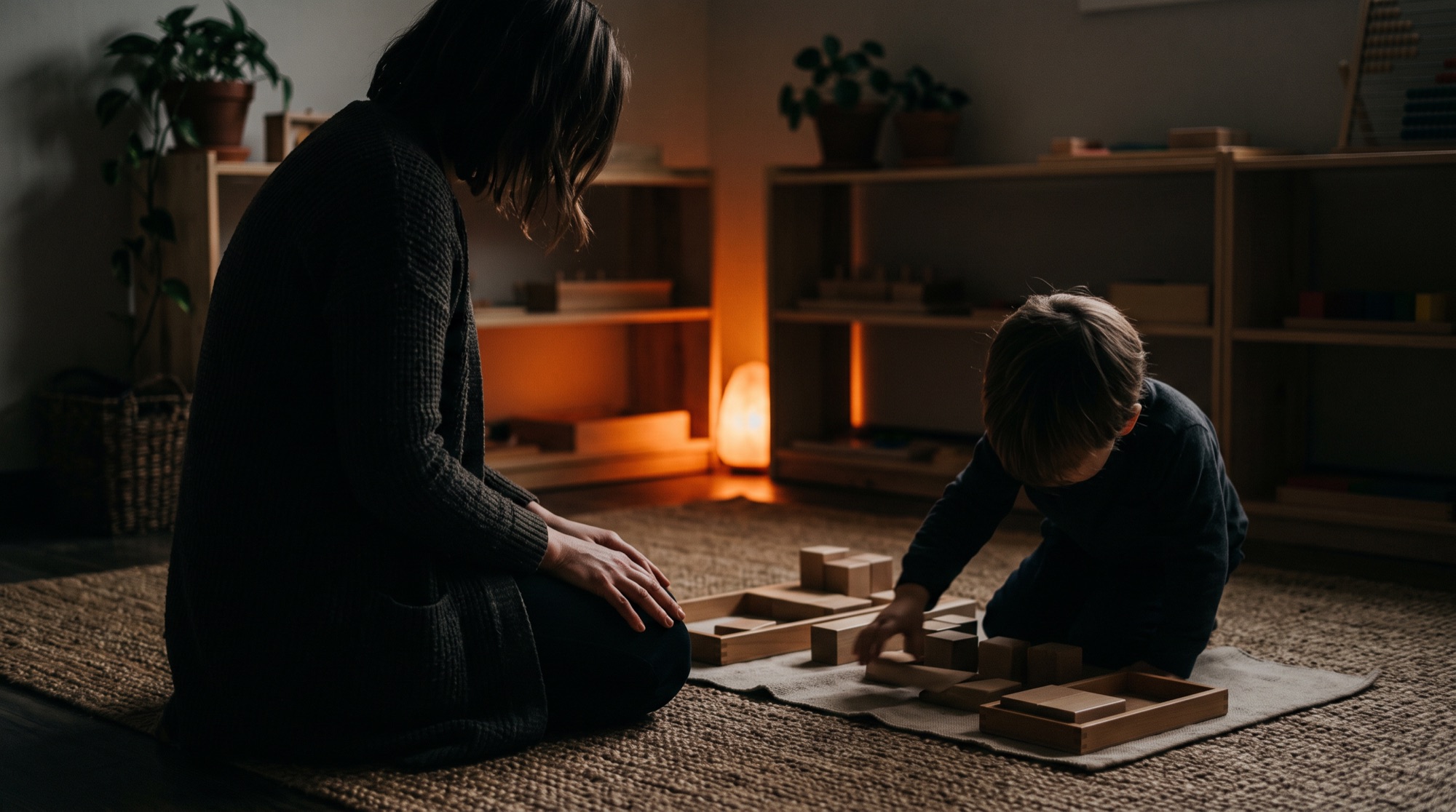
Step back
Then comes the hardest part. The guide moves away and lets the child struggle a little, repeat, and eventually finish. It is natural for adults to want to help the moment a small child frustrates, and most of us have to unlearn it. Montessori educators often describe the aim as helping the child to do it alone. If the child asks for help, the guide gives the smallest amount that works, and then withdraws again.
Parents sometimes worry that this means the child is on their own. It does not. The guide is always present, always watching, and always ready. What she holds back is not attention but interference.
Mixed ages in one room
One of the first things a visitor notices is that the children are not all the same age. In most Montessori rooms for ages three to six, three-year-olds share space with four-, five- and six-year-olds. Toddler rooms and elementary classrooms also group children across a span of years.
This is a deliberate choice, and it is one of the most useful features of the method once you see it working.
What younger children gain
A three-year-old in a mixed room is surrounded by models. She sees a five-year-old carry a tray without spilling, hears an older child say please and thank you, and watches how a six-year-old settles into a long piece of work. Younger children learn an enormous amount simply by watching, and the work they see is always just a little beyond what they can do themselves, which is exactly where interest is strongest. There is also a social ease to it. A shy three-year-old can ask an older child for help without feeling she is being tested.
What older children gain
Older children, for their part, consolidate what they know by sharing it. Explaining how to wash a table or thread a button, or showing a younger child where a material belongs, forces a child to understand it properly. It is also good for confidence and for empathy. Many guides notice that a child who struggles with something often blossoms when asked to help someone else with it. The oldest children in the room become, in time, the example the youngest follow, and the room carries its culture from one year to the next largely through those children.
Freedom within limits
The phrase "freedom within limits" is often used to summarise the Montessori approach to behaviour, and it describes the day well.
Children have real freedom: to choose their work, to work alone or with a friend, to move about the room, to repeat something as many times as they like, to stop when they are done. This freedom is what allows the deep concentration described earlier.
It is paired with clear limits, set calmly and consistently. Exactly what they are varies by classroom, but the core ideas are widely shared:
- We take care of ourselves.
- We take care of each other.
- We take care of the room and everything in it.
- Materials are used for their purpose and returned to their place when we are done.
- We do not disturb someone who is working.
These ground rules do not need to be enforced loudly. Because they are simple and fair and the same for everyone, children absorb them. When a child does cross a line, the response tends to be calm, specific and private: a quiet word, a reminder, a redirection to other work, or help to repair what was broken. The message is not "you are bad" but "this is how we do things here, and you can do it too".
Grace and courtesy
Manners are taught directly, and they are taught as skills. In what Montessori classrooms call grace and courtesy lessons, a guide demonstrates, often with a puppet or a role-play, how to do ordinary social things: how to say excuse me, how to ask to join someone's work, how to walk around another child's mat rather than across it, how to carry a chair, how to offer a tissue to a friend. Children are shown the movement and the words, and then given plenty of chances to practise.
This turns out to be powerful for very young children. A toddler who has watched how to say "may I have a turn" may not use the words perfectly, but she has a clear picture of what the right thing looks like. The same goes for conflict. A child who has been shown how to say "please stop, I do not like that" has a better option than grabbing or shouting.
Snack and lunch
Meals are part of the curriculum, not a break from it. In many Montessori rooms, snack is available during the work cycle rather than served to everyone at once, so that a child can eat when she is hungry and carry on working afterwards. A small table is set with real plates and glasses, a pitcher, and a modest amount of food prepared by the children or an adult.
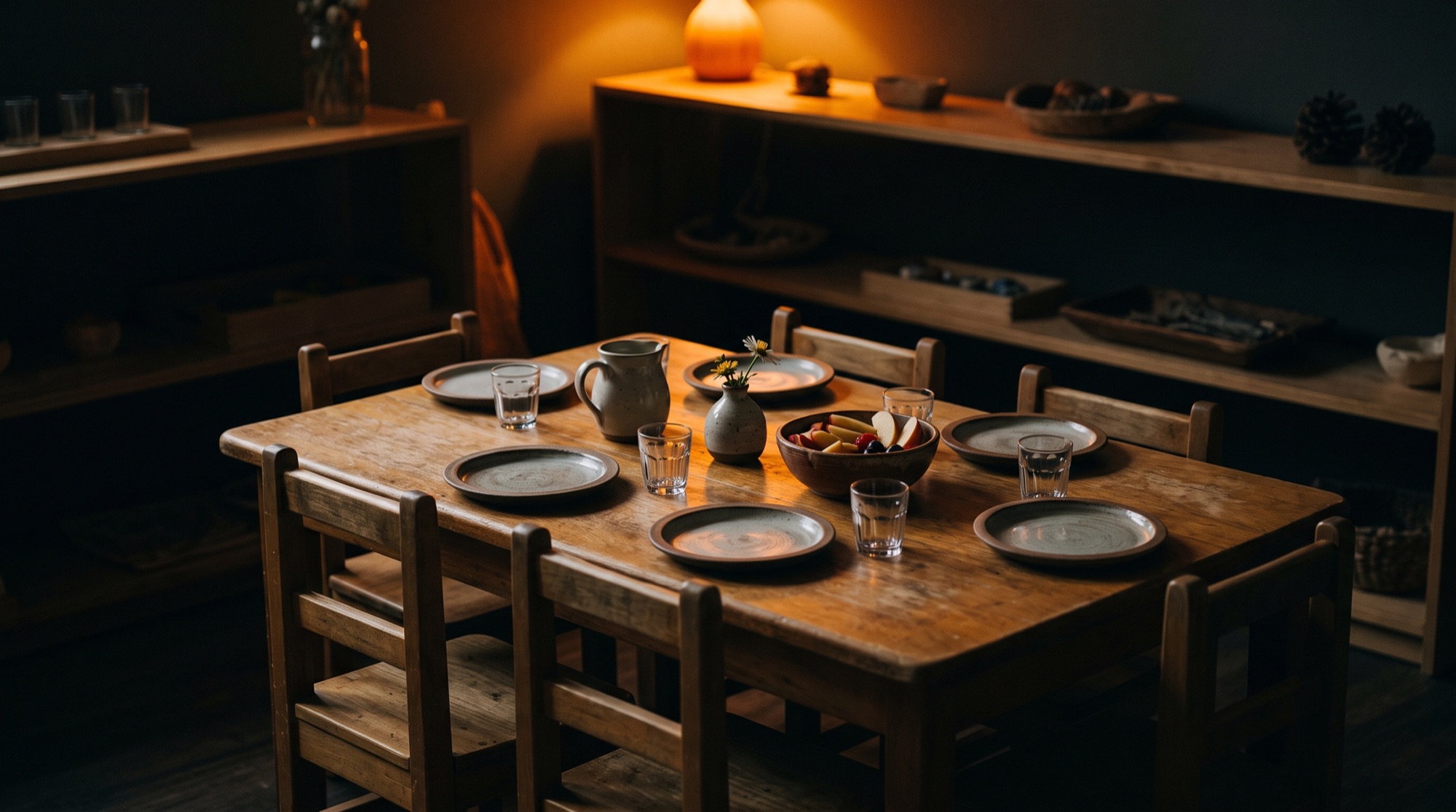
Even the youngest children often prepare their own food: peeling a banana, slicing soft fruit with a child-safe knife, spreading, pouring their own water. Afterwards they clear their own plate, wipe the place mat and push in the chair. Each step is a practical life lesson, repeated daily, and it adds up. Parents are often astonished by what three-year-olds can do at the table once they are shown how and trusted to try. A child who can pour her own water at school will frequently start asking to do it at home, which is one of the most common reports parents give.
Lunch is a calmer, shared occasion. Children sit together, often at small tables of four, with the guide eating nearby. Conversation is encouraged but kept at a comfortable volume. Children learn to serve themselves, to wait, to say thank you, and to tidy up. The experience tends to build a sense of belonging as much as it satisfies appetite.
Outdoor time, movement and rest
Maria Montessori was emphatic that young children need to move, and that movement and thinking are closely linked. Outdoor time is therefore a regular part of the day, not a reward. In a Surrey climate, that includes plenty of days in rain jackets and boots, and most educators will tell you the children rarely mind.
Outside, children run, climb, dig, carry, sweep leaves, water a garden and simply watch things. Gardening is a favourite: planting seeds, watching them sprout, watering and weeding give small children a real responsibility and a long, slow lesson in patience and cause and effect. Many classrooms also bring the outdoors in with plants to care for, a nature table, or a tray of seasonal things collected on a walk.
Rest for the youngest
Toddlers and many younger preschoolers need a rest in the middle of the day, and a good program plans for it. A darkened, quiet space, a small mat or cot, a familiar routine and soft music or silence help most children settle. Some fall asleep quickly, and some do not sleep at all but benefit from lying quietly. Older children who have outgrown a nap often move to quiet work, such as a book, a puzzle or a drawing, so that the room has a restful stretch even without sleep.
If your child still naps, say so on your tour and ask how the room handles it, how long the rest period is, and what happens for the child who wakes early.
The end of the day
Just as the arrival is a ritual, so is the close. Children tidy, which in a Montessori room means returning every material to its place so the room is ready for tomorrow. This is a practical habit and a point of pride. A group gathering often follows: a song, a story, a few words about the day, a goodbye. Children collect their belongings, hang up their name tags, put on shoes and jackets, and greet their parents at the door.
When you arrive for pickup, you may find your child calm, absorbed in a last piece of work, or noticeably tired. Try not to start with a volley of questions. "How was your day?" often meets silence at this age. A better way in is to give a quiet hug, walk home together and wait. The stories usually come out later, often at bath time or on the way to bed, one small piece at a time. You can also ask the guide for a short note: what your child worked on, what they enjoyed, anything to carry over at home.
How progress is seen, without grades
Parents who are used to marks and report cards sometimes ask how they will know their child is doing well. The answer is that it is seen more closely, not less.
Guides keep ongoing records of what each child has been introduced to, what they are practising, and what they have mastered. These are detailed and individual, and they are the basis for deciding what to offer next. Progress is described in terms of what the child can now do and what is emerging, not in terms of rank or comparison with other children. Families commonly see this in the form of conferences, written observations, and a conversation that begins with what your child is really interested in.
There is also a quieter kind of evidence that parents often notice before any report arrives. A child who has been practising pouring begins to pour her own milk. A child who has learned to wait his turn starts waiting at home. A child who tidied a shelf at school offers to tidy her room. These small signs are the day's work showing up in your living room.
Beyond age six: elementary and before and after school
Children from about six to twelve are in a different stage of development, and the classroom changes with them. The core ideas stay the same: a prepared environment, choice within a framework, mixed ages, and guides who observe more than they direct. What shifts is the focus.
Where the younger child is absorbed in the senses and in practical, concrete work, the elementary child tends to be hungry for the big picture. Why is the world the way it is? How did people live long ago? How do things connect? In many Montessori elementary programs, learning is organised around these large questions and around research, discussion, projects and collaboration. Children work in small groups, plan their own work with guidance, go deep into topics they care about, and often present what they have learned to others.
The three-year-old's hands-on materials give way to more abstract work, though concrete tools are still used when they help. Children take on more responsibility for their own time and their own plans, practise working with others, and use the classroom as a base for learning that reaches beyond it.
Before and after school
Silver Ridge's elementary program serves children from six to twelve and is offered as before and after school care. For many families this is a practical question first: a safe, calm, well-run place before and after the school day. In a Montessori setting, those hours carry something of the same philosophy. Children are not simply parked in front of a screen. They have space to finish work, read, move, play and unwind after a long day, with adults who know them. A school-aged child who has been in a busy room all day often needs exactly that: a place to unwind that still respects her independence and her interests.
If you are looking at the elementary program, ask to see the room and to hear how the hours are structured, how homework and quiet time are handled, and how children of different ages work and play together. More detail is on the elementary program page.
| Age group | What the day tends to emphasise | Rhythm |
|---|---|---|
| Toddlers (about 18 to 36 months) | Movement, language, self-care, practical life, sensory exploration | Gentle and short work periods, more rest, familiar routines |
| Primary (about 3 to 6 years) | The full set of five areas, concentration, early reading, writing and number | A long, uninterrupted morning work cycle, lunch, outdoor time, quieter afternoon |
| Elementary (about 6 to 12 years) | Big questions, research, collaboration, responsibility for planning | Longer projects, group work, and before and after school care |
The first days and the first few weeks
If your child is about to start, it helps to know what is likely to happen, because the early weeks are rarely a straight line.
The first day
Expect a short visit or a shorter first day if the school offers one. Children often spend the first hours watching. This is a good sign, not a worrying one. A new child usually needs time to take in the room before taking part in it. The guide will give her something simple and inviting to do, often a practical life work, and will keep a close eye.
The first week
Separation is the main event. Some children cry at the door every day for a week or two. Some seem fine at first and then have a hard time on day four or five, when the novelty wears off and they realise this is going to keep happening. This is very common and does not mean the placement is wrong. Keep your goodbyes warm, short and consistent, and trust the guide to help your child through it. Most children find their feet quickly once a routine takes hold.
Tired afternoons and tricky evenings
A day of constant, self-directed concentration is a full day, even for a child who has not run around. Many children come home from school in the early weeks exhausted. They may be clingy, tearful, hungry or very short-tempered at five o'clock, and may have a meltdown over something small. That is usually tiredness, not unhappiness. A quiet snack, a bath, an early bedtime and a lot of patience help. It usually settles within a few weeks as stamina grows.
What to look for on a tour
A tour is your best chance to see a Montessori day in real life. If possible, ask to observe during the morning work cycle, when the classroom is at its most representative. Here is a simple list of things worth noticing. Use it as a prompt for your own observations, not as a scorecard.
In the room
- Is the room calm and orderly, with low shelves and materials that look cared for and complete?
- Are there child-sized tables, chairs, sinks, hooks and tools that children can use without asking?
- Is there one of each material, arranged neatly and in a clear order?
- Can you see all five areas: practical life, sensorial, language, math and culture, or their equivalents for the age group?
- Is there a place for plants, art and something beautiful that children have made?
In the children
- Are most children engaged in something, even if they are not all doing the same thing?
- Do you see children choosing, carrying, working, tidying and moving around the room with purpose?
- Do older and younger children interact kindly?
- Is the sound level a busy hum rather than shouting or complete silence?
- Do the children seem at ease with the adults?
In the adults
- Is the guide mostly observing and giving brief individual lessons, rather than directing the whole room?
- Does she speak to children at eye level and with respect?
- Do you see her step back and let a child struggle, rather than rush in?
- How does she handle a small conflict or a child who is upset?
- Does she seem to know each child well?
Frequently asked questions
Is a Montessori classroom just children doing whatever they like?
No. Children choose their work, but they choose from a prepared selection that the guide has set out for them, and they follow ground rules about safety, respect and care for the room. The guide watches closely and guides each child toward what they are ready for. Freedom is real, and so are the limits that make it work.
What if my child always chooses the same work?
Repetition is normal and valuable. Small children often return to the same work many times because they are consolidating a skill, and this is part of how concentration grows. A guide will notice if a child stays with the familiar too long or avoids challenge, and will gently introduce something new, often through a short lesson.
Will my child learn to read, write and count?
Yes. In a Montessori classroom, these skills are introduced through concrete materials and at a pace that suits each child. Many children start with sounds and letters, build words with a movable alphabet, and move into reading and writing in their own time. Math begins with handling real quantities and moves toward written numbers. Ask the guide to show you how it works in the room.
How is it different from a daycare or a conventional preschool?
The biggest differences are the long, uninterrupted work cycle, the prepared environment with its specific materials, the guide's focus on observing and giving brief individual lessons, and the mixed-age grouping. In a conventional setting, a teacher more often leads the day and the whole group does the same activity at the same time. Many families find the Montessori approach calmer and more respectful of the child's own pace, but the best test is to visit and watch.
Seeing it for yourself
A Montessori day is easy to describe and surprisingly hard to appreciate from a description. The calm is something you feel when you stand in the doorway. The concentration is something you see on a small child's face. The independence is in the way a three-year-old carries her tray to the table and does not look around to check whether anyone saw.
If you would like to see how this works for your child's age, you are welcome to visit. You can read more about our toddler program, our primary program and our elementary program, or learn about our school before you come. When you are ready, get in touch to arrange a tour at a campus in Fleetwood, Cloverdale, Clayton or on 163 Street in Surrey. Bring your questions, and your child if you like. There is usually no better answer than watching a morning unfold.